
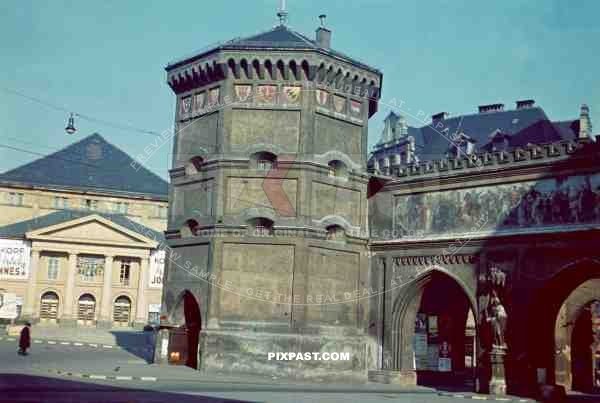
Isartor Gate and Atlantik Palast Cinema in Munich, Germany, circa 1942
Digital Download Only: Upon purchase and successful payment, you will receive the selected image as a high-resolution JPG digital download. No physical photographs or printed copies are included in this transaction.
File details: JPG • 5,000 × 3,364 pixels
Isartor Gate and Atlantik Palast Cinema in Munich, Germany, circa 1942
Description
This original color photograph shows the Isartor gate in Munich, Germany, dating to around 1942, as suggested by the filename. It features the medieval Isartor, one of the city's old gates, with its octagonal tower and decorated crenellations clearly visible. To the left of the gate stands the Atlantik Palast Cinema, formerly the Isartortheater, identifiable by its neoclassical façade and large entrance. This cinema building was destroyed in 1944 during World War II. The photograph's hue and quality suggest it is an Agfacolor slide, consistent with the wartime color photographic technology used in Germany during the early 1940s. No vehicles are visible in the image, and the setting appears calm, with no overt war-related activity. This photograph holds historical value for studying Munich's urban architecture and cultural sites before wartime destruction.
Dieses Originalfarbfoto zeigt das Isartor in München, Deutschland, etwa um 1942, wie der Dateiname nahelegt. Das Bild zeigt das mittelalterliche Isartor, eines der alten Stadttore, mit seinem oktogonalen Turm und den verzierten Zinnen. Links vom Tor befindet sich der Atlantik Palast Kino, ehemals Isartortheater, erkennbar an seiner neoklassizistischen Fassade und dem großen Eingang. Das Kino wurde 1944 im Zweiten Weltkrieg zerstört. Die Farbtöne und die Qualität deuten auf einen Agfacolor-Diafilm hin, der der in Deutschland in den frühen 1940er Jahren verwendeten Farbfilme entspricht. Es sind keine Fahrzeuge zu sehen. Die Szene wirkt ruhig, ohne sichtbare kriegsbezogene Aktivitäten. Dieses Foto ist historisch wertvoll für das Studium der städtischen Architektur Münchens vor der Zerstörung und der kulturellen Orte während der Kriegszeit.
Related products
-
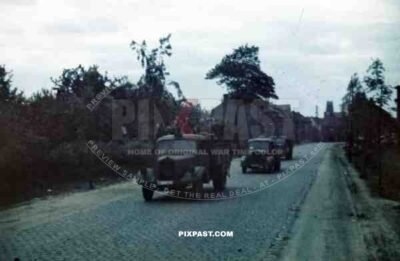
Wehrmacht Truck Carrying Prisoners on Road Near Tongeren, Belgium, 1940
Add to cart -
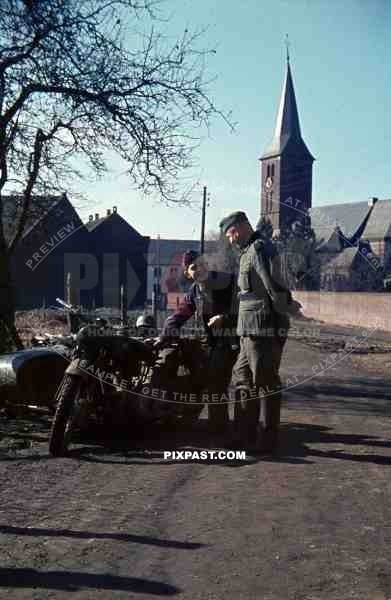
Wehrmacht Soldiers with NSU Motorcycle in Niederaussem, Germany 1940
Add to cart -
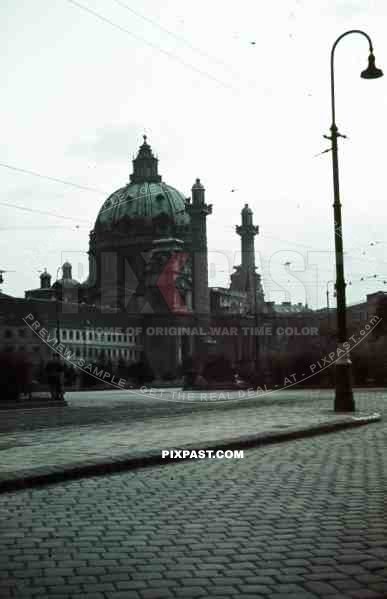
Karlskirche (St. Charles’s Church) Vienna, Austria 1939
Add to cart -
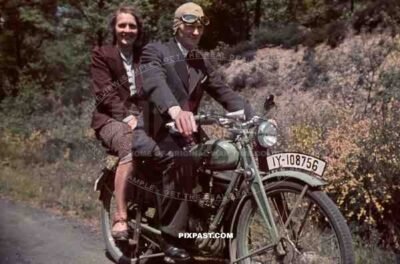
Bremerhaven 1939 NSU Motorcycle with Riding License IY-108756, Helmet and Goggles
Add to cart