
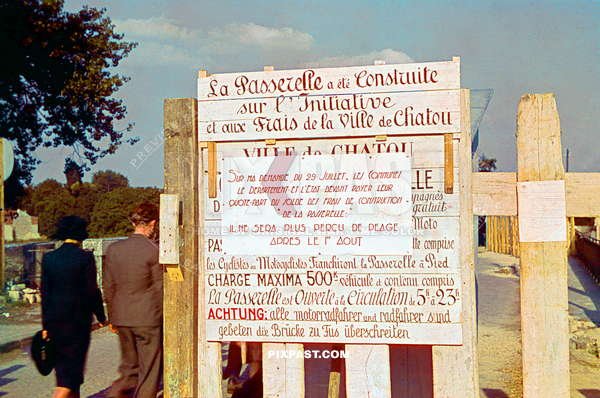
Informational Bridge Sign in Chatou near Orléans, France, June 1940
Digital Download Only: Upon purchase and successful payment, you will receive the selected image as a high-resolution JPG digital download. No physical photographs or printed copies are included in this transaction.
Informational Bridge Sign in Chatou near Orléans, France, June 1940
Description
This original 1940 color photograph shows a large, hand-painted informational sign posted at the footpath entrance to a bridge in Chatou, a commune near Orléans, France. The sign is primarily in French but includes a warning in German, reflecting the historical context of German occupation following the 1940 invasion of France during World War II. It states that the footbridge was built at the initiative and expense of the town of Chatou. The sign announces that toll fees will be removed starting August 1st and sets a maximum vehicle load of 500 kilograms. Cyclists and motorcyclists are instructed to walk their vehicles across the bridge.
Mounted on a wooden fence near the bridge entrance, the sign appears alongside two pedestrians walking toward it. The bilingual text illustrates the administrative conditions under wartime occupation in the summer of 1940. No vehicles are present in the image, so vehicle identification is not applicable. This photograph offers historical insight into local civic regulation and infrastructure during the occupation.
Cette photographie couleur originale de 1940 montre un grand panneau informatif peint à la main, affiché à l'entrée d'un pont piétonnier à Chatou, une commune proche d'Orléans, en France. Le panneau est rédigé principalement en français avec un avertissement en allemand, reflétant le contexte historique de l'occupation allemande après l'invasion française en 1940 durant la Seconde Guerre mondiale. Le texte explique que la passerelle a été construite à l'initiative et aux frais de la ville de Chatou, que les péages seront supprimés à partir du 1er août, et fixe une charge maximale de 500 kilogrammes par véhicule. Les cyclistes et motocyclistes sont invités à traverser à pied. Le panneau est fixé à une structure de clôture en bois à l'entrée du pont, avec deux piétons visibles à proximité se dirigeant vers lui. Le caractère bilingue du panneau illustre les conditions d'administration sous occupation en été 1940. Aucune voiture n'étant visible, l'identification de véhicules n'est pas applicable. La photographie donne un aperçu historique de la réglementation locale et des infrastructures civiles sous occupation.
Related products
-
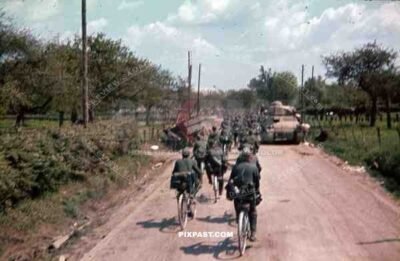
French Somua S-35 Medium Tank with German Bicycle Troops on Road in France, 1940
Add to cart -
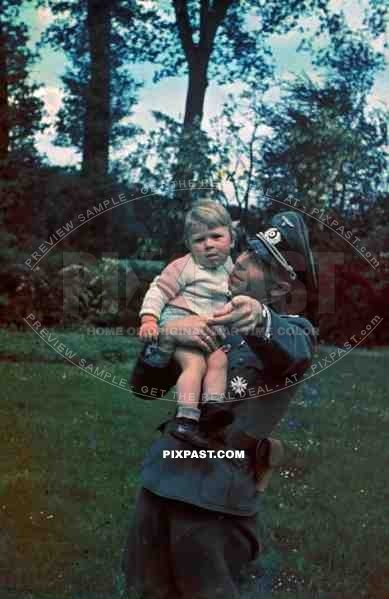
World War II German Cavalry Officer with Child, Frankfurt 1940
Add to cart -
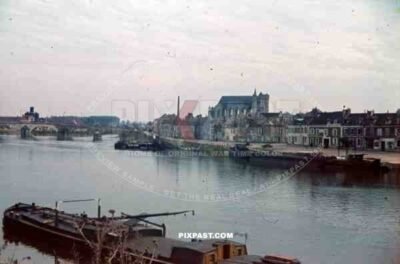
River Scene with Boats and Historic Bridge in Montereau-Fault-Yonne, France, 1940
Add to cart -
WW2 Color Photograph of Luftwaffe Officer Bindewald in Bombed Krakow, Poland, 1940
Add to cart
Reviews
There are no reviews yet.