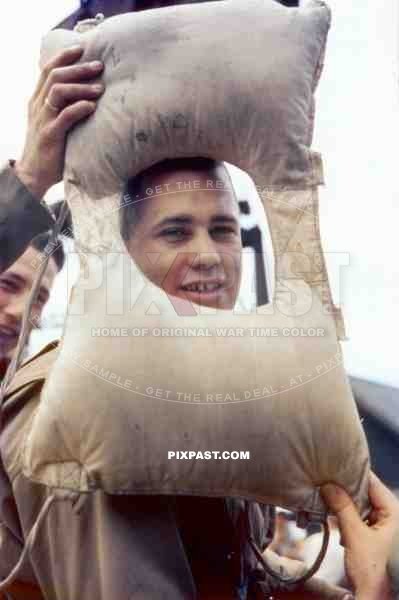
American GI with Life Jacket Onboard Landing Craft off Omaha Beach, Normandy 1944
Digital Download Only: Upon purchase and successful payment, you will receive the selected image as a high-resolution JPG digital download. No physical photographs or printed copies are included in this transaction.
File details: JPG • 3,331 × 5,000 pixels
American GI with Life Jacket Onboard Landing Craft off Omaha Beach, Normandy 1944
Description
This original color photograph shows an American soldier, a GI, wearing his life jacket on board a landing craft offshore from Omaha Beach in Normandy, France. The image captures a moment shortly after D-Day, specifically on D-Day plus 10, in 1944 during the Allied operations in the Normandy invasion. The soldier smiles while holding the inflated life jacket around his head. Set against a bright overcast sky, the scene conveys both the intensity and relief of the amphibious campaign. Lieutenant Joseph M. Zinni of the 166th Signal Photo Company took the photograph. His unit is known for documenting the D-Day landings with authentic and rare color footage. The filename and archive notes confirm the location as Normandy and the date as 1944, matching the soldier’s uniform and the historical military context.
Cette photographie originale en couleur montre un soldat américain, un GI, portant son gilet de sauvetage à bord d’un navire de débarquement au large de la plage d’Omaha en Normandie, France. L’image capture un moment peu après le jour J, précisément le jour J plus 10, en 1944 lors des opérations alliées lors de l’invasion de la Normandie. Le soldat sourit en tenant le gilet de sauvetage gonflé autour de sa tête. La scène se déroule sous un ciel clair et couvert, suggérant l’intensité et le soulagement de la campagne militaire amphibie. La photo a été prise par le lieutenant Joseph M. Zinni de la 166e compagnie de photographie du signal, connu pour avoir documenté les débarquements du jour J avec des images rares et authentiques en couleur. Le nom de fichier et les notes d’archives confirment le lieu comme la Normandie et la date comme 1944, en accord avec le contexte militaire historique et l’uniforme porté par le soldat.