
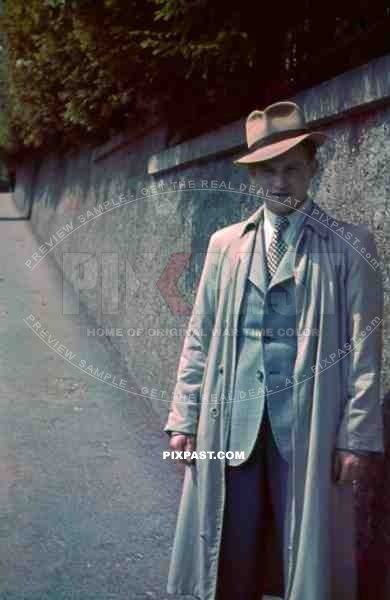
WW2 Era Soldier in Civilian Clothes with Hat Salzburg 1940
Digital Download Only: Upon purchase and successful payment, you will receive the selected image as a high-resolution JPG digital download. No physical photographs or printed copies are included in this transaction.
File details: JPG • 3,256 × 5,000 pixels
WW2 Era Soldier in Civilian Clothes with Hat Salzburg 1940
Description
This original color photograph shows a man standing outdoors beside a stone or concrete wall topped with greenery. He wears civilian clothes typical of the early 20th century: a light-colored trench coat over a suit with a vest, a checkered tie, and a wide-brimmed hat. The filename and archival context identify him as a soldier or war photographer ("Kriegsberichter") in civilian attire, photographed in Salzburg, Austria, around 1940. Produced on Agfacolor film during World War II, the image shows no visible military insignia or equipment to confirm his soldier status. It captures the blending of military and civilian life in wartime Austria, a country annexed by Nazi Germany in 1938. While the filename lists the date as 1940, this remains unverified but plausible. The subject’s clothing and setting align with the era and location.
Dieses originale Farbfoto zeigt einen Mann, der im Freien neben einer Stein- oder Betonmauer steht, über der sich etwas Grünzeug befindet. Er trägt zivile Kleidung, die für das frühe 20. Jahrhundert typisch ist: einen hellen Trenchcoat über einem Anzug mit Weste, eine karierten Krawatte und einen breitkrempigen Hut. Der Dateiname und der Archivkontext identifizieren ihn als Soldaten oder Kriegsberichterstatter in ziviler Kleidung in Salzburg, Österreich, um 1940. Das Foto stammt aus der Zeit des Zweiten Weltkriegs und wurde auf Agfacolor-Film aufgenommen. Es sind keine sichtbaren militärischen Abzeichen oder Ausrüstungen zu erkennen, um seinen Soldatenstatus visuell zu bestätigen. Das Bild zeigt die Verschmelzung von militärischem und zivilem Leben im kriegsgeprägten Österreich, das 1938 von Nazi-Deutschland annektiert wurde. Obwohl das Datum im Dateinamen als 1940 angegeben ist, wird dies als unbelegt aber plausibel erhalten. Die Kleidung und der Hintergrund passen zur Epoche und zum Ort.
Related products
-
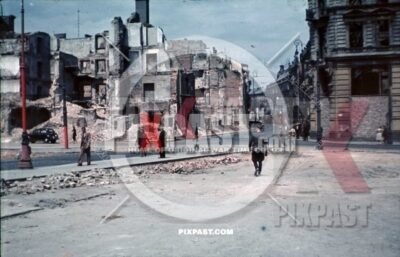
WW2 Color Photograph of Luftwaffe Officer Bindewald in Bombed Krakow, Poland, 1940
Add to cart -
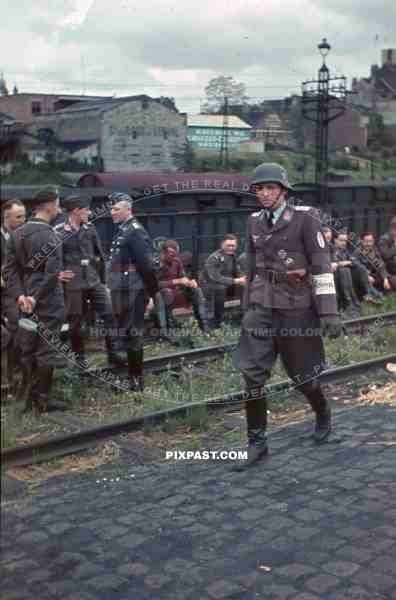
Luftwaffe Field Division Soldiers at Train Station, Etterbeek, Brussels, Belgium, 1941
Add to cart -
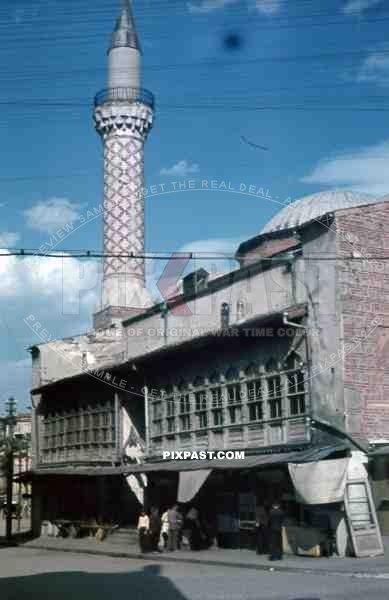
Dzhumaya Mosque and Market Buildings in Plovdiv, Bulgaria 1942
Add to cart -
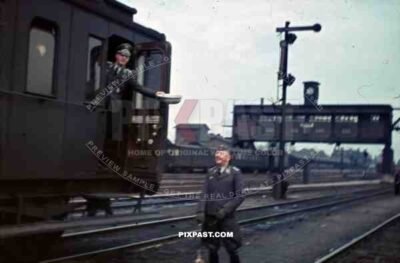
Luftwaffe Officers Cleaning Train Toilet at Stendal Railway Yard, Germany 1940
Add to cart