
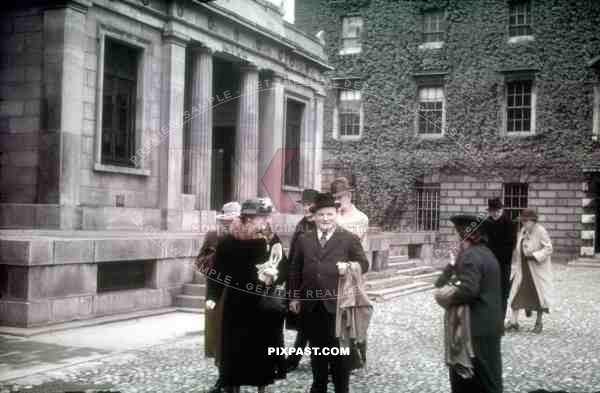
Group of Visitors Outside Trinity College Dublin, Ireland, circa 1939
Digital Download Only: Upon purchase and successful payment, you will receive the selected image as a high-resolution JPG digital download. No physical photographs or printed copies are included in this transaction.
File details: JPG • 5,000 × 3,282 pixels
Group of Visitors Outside Trinity College Dublin, Ireland, circa 1939
Description
This original historical colour photograph shows a group of visitors standing outside a building at Trinity College in Dublin, Ireland, believed to be taken around 1939. The image features a cobblestone courtyard with ivy-covered walls of nearby college buildings and a classical entrance with columns. The visitors, dressed in period attire including coats and hats, gather in small clusters.
The filename and archive context identify this site as the war memorial at Trinity College Dublin. However, the photograph mainly captures the social scene outside the building rather than the memorial itself. No vehicles or transport appear in the image. The photograph’s colours and style suggest it is an Agfacolor slide. Although the archive also mentions Germany and 1940, the visual evidence firmly supports the Irish location and the period around 1939.
Cette photographie couleur historique originale montre un groupe de visiteurs devant un bâtiment du Trinity College à Dublin, en Irlande, probablement prise vers 1939. On voit une cour pavée avec des murs couverts de lierre des bâtiments universitaires adjacents et une entrée classique avec colonnes. Les visiteurs, vêtus de manteaux et chapeaux anciens, se tiennent en petits groupes. Le nom de fichier et le contexte d'archive indiquent qu'il s'agit d'un site de mémorial de guerre au Trinity College de Dublin, mais la photo montre surtout une scène sociale à l'extérieur du bâtiment plutôt que le mémorial lui-même. Aucune voiture identifiable n'apparaît. Les couleurs et le style suggèrent une diapositive Agfacolor. Malgré le contexte mentionnant aussi l'Allemagne en 1940, les éléments visuels confirment clairement ce lieu en Irlande vers 1939.
Related products
-
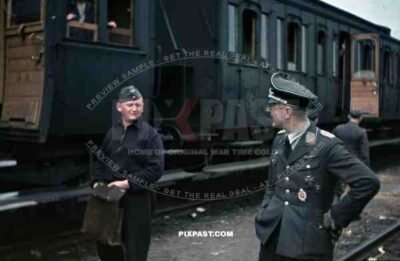
Luftwaffe Pilot with Awards at Railway Yard, Stendal, Germany, 1940
Add to cart -
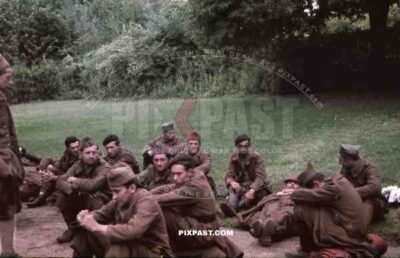
French Army POW Soldiers Near Verdun, France, 1940
Add to cart -
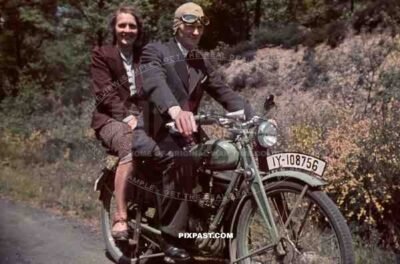
Bremerhaven 1939 NSU Motorcycle with Riding License IY-108756, Helmet and Goggles
Add to cart -
Luftwaffe Officers Cleaning Train Toilet at Stendal Railway Yard, Germany 1940
Add to cart