
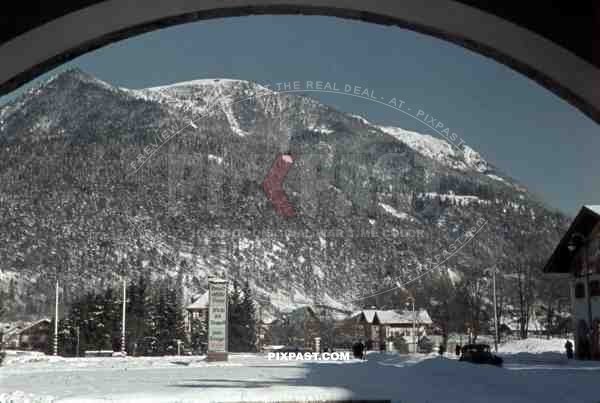
View of Wank Mountain in Garmisch-Partenkirchen, Germany circa 1941
Digital Download Only: Upon purchase and successful payment, you will receive the selected image as a high-resolution JPG digital download. No physical photographs or printed copies are included in this transaction.
File details: JPG • 5,000 × 3,366 pixels
View of Wank Mountain in Garmisch-Partenkirchen, Germany circa 1941
Description
This original color photograph captures a winter scene looking toward Wank mountain in Garmisch-Partenkirchen, Bavaria, Germany, around 1941. The snow-covered Alpine landscape dominates the background, framed by an arch structure in the foreground. Below the mountain, buildings typical of the Bavarian region are visible, along with a road where an early 1940s car is parked.
A prominent stele with an inscription referencing the Winterhilfswerk (WHW) charity campaign stands nearby. It reads, "Heimat erfülle deine Pflicht. Gib doppelt zum W.H.W.," which translates as "Homeland, fulfill your duty. Give double to the Winter Relief." The photograph is an Agfacolor slide, a color film popular in Germany during the late 1930s and early 1940s. Together, the alpine scenery, local architecture, and wartime WHW slogan place this image as a historical record of civilian life and community efforts in Bavaria during World War II.
Dieses Originalfarbfoto zeigt eine Winterlandschaft mit Blick auf den Wank bei Garmisch-Partenkirchen, Bayern, Deutschland, um das Jahr 1941. Die schneebedeckten Alpen dominieren den Hintergrund und sind von einer Bogenstruktur im Vordergrund umrahmt. Unterhalb des Berges sind typische Gebäude der bayerischen Region zu sehen, ebenso wie eine Straße mit einem geparkten Auto aus der frühen 1940er-Zeit. Eine prominente Stele mit der Inschrift „Heimat erfülle deine Pflicht. Gib doppelt zum W.H.W.“ ist sichtbar. Diese Phrase bezieht sich auf das Winterhilfswerk (WHW) und bedeutet „Heimat, erfülle deine Pflicht. Gib doppelt zum Winterhilfswerk.“ Das Foto ist eine Agfacolor-Diaserie, eine in Deutschland in den späten 1930er- und frühen 1940er-Jahren beliebte Farbfilmtechnik. Die Kombination aus Alpenlandschaft, lokaler Architektur und dem WHW-Slogan aus der Kriegszeit macht dieses Bild zu einem historischen Dokument des bayerischen Zivillebens und der gemeinschaftlichen Anstrengungen während des Zweiten Weltkriegs.
Related products
-
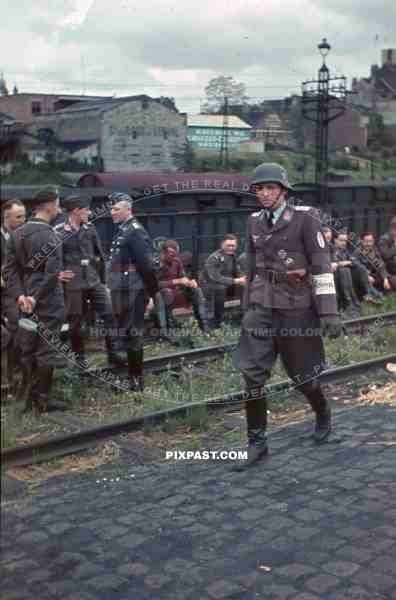
Luftwaffe Field Division Soldiers at Train Station, Etterbeek, Brussels, Belgium, 1941
Add to cart -
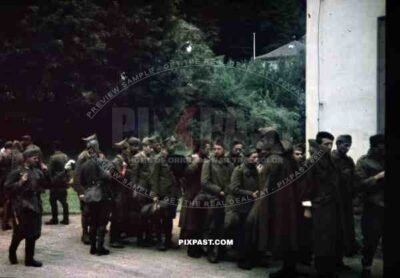
French Army POW Soldiers Near Verdun, France, 1940
Add to cart -
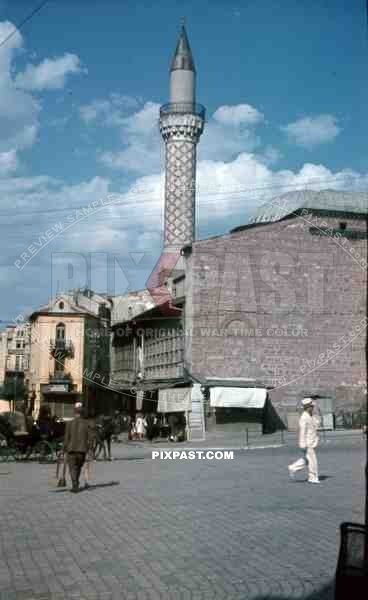
Dzhumaya Mosque and Street Scene in Plovdiv, Bulgaria, 1942
Add to cart -
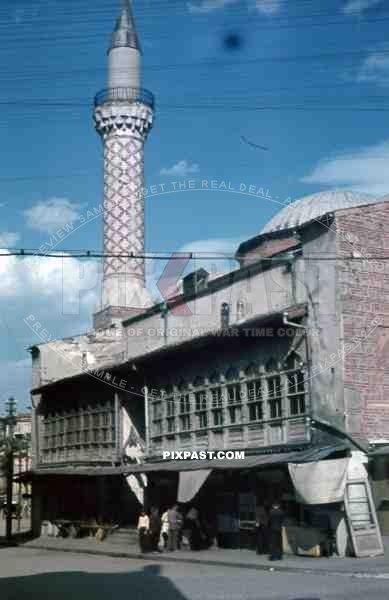
Dzhumaya Mosque and Market Buildings in Plovdiv, Bulgaria 1942
Add to cart