

US M8 Greyhound Armoured Car Crash Outside Bad Tölz, Bavaria, 1945
Digital Download Only: Upon purchase and successful payment, you will receive the selected image as a high-resolution JPG digital download. No physical photographs or printed copies are included in this transaction.
File details: JPG • 5,000 × 3,354 pixels
US M8 Greyhound Armoured Car Crash Outside Bad Tölz, Bavaria, 1945
Description
This color photograph shows a crashed US M8 Greyhound armored car on a dirt road outside Bad Tölz in Bavaria, Germany, in 1945. The vehicle lies tipped on its side next to a grassy field bordered by forested hills. Several American soldiers in World War II uniforms stand nearby, inspecting the scene.
The image is historically important as it captures a moment from the final year of the war in Western Europe involving the 101st Mechanized Cavalry Regiment. The M8 Greyhound, a six-wheeled light armored car used for reconnaissance, is clearly identifiable by its shape, on-road tires, and turret with mounted armament. The location in Bavaria and the 1945 date align with the final Allied advances into Germany. The surrounding terrain reveals a rural setting with mixed farmland and wooded hills typical of the Bavarian Alps foothills.
Dieses Farbfoto zeigt ein abgestürztes US-amerikanisches M8 Greyhound-Panzerfahrzeug auf einem unbefestigten Weg außerhalb von Bad Tölz in Bayern, Deutschland, im Jahr 1945. Das Fahrzeug liegt auf der Seite neben einem grasbewachsenen Feld, das von bewaldeten Hügeln umgeben ist. Mehrere amerikanische Soldaten in Uniformen des Zweiten Weltkriegs stehen in der Nähe und begutachten die Situation. Das Bild ist historisch bedeutsam, da es einen Moment aus dem letzten Kriegsjahr in Westeuropa mit dem 101. Mechanisierten Kavallerieregiment zeigt. Der M8 Greyhound, ein sechsrädriges leicht gepanzertes Fahrzeug, das für Aufklärungszwecke verwendet wurde, ist anhand seiner Form, der Straßenreifen und des Turms mit montierter Bewaffnung gut erkennbar. Der Standort in Bayern und das Jahr 1945 stimmen mit den letzten alliierten Vorstößen in Deutschland überein. Das umliegende Gelände zeigt eine ländliche Umgebung mit Mischlandwirtschaft und bewaldeten Hügeln, typisch für die Voralpenregion Bayerns.
Related products
-
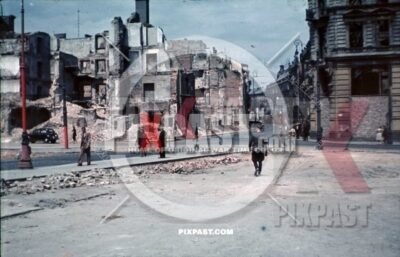
WW2 Color Photograph of Luftwaffe Officer Bindewald in Bombed Krakow, Poland, 1940
Add to cart -
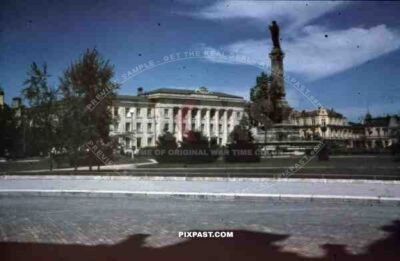
Liberty Monument and Courthouse in Ruse, Bulgaria, 1943
Add to cart -
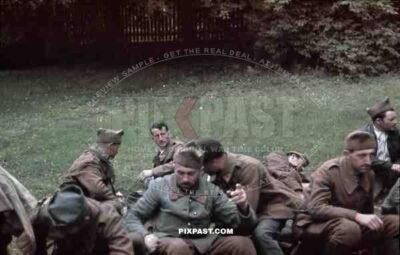
French Army POW Soldiers Near Verdun, France, 1940
Add to cart -
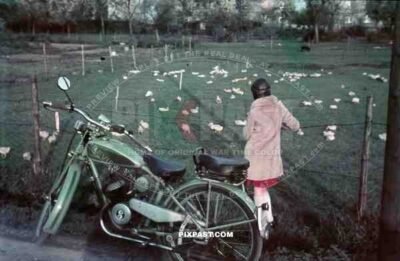
Woman in Red Skirt and Leather Helmet with Motorcycle Watching Ducks in Bremerhaven, Germany, 1939
Add to cart