
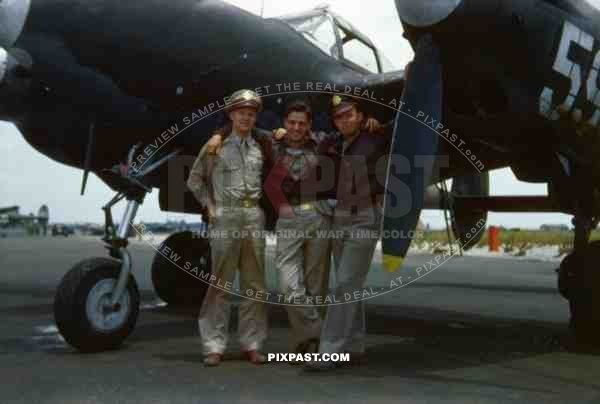
United States Air Force Lockheed P-38 Lightning Fighter at Clark Air Base, Luzon Island, 1945
Digital Download Only: Upon purchase and successful payment, you will receive the selected image as a high-resolution JPG digital download. No physical photographs or printed copies are included in this transaction.
File details: JPG • 5,000 × 3,367 pixels
United States Air Force Lockheed P-38 Lightning Fighter at Clark Air Base, Luzon Island, 1945
Description
This original color photograph shows three United States Air Force airmen posing in front of a Lockheed P-38 Lightning fighter aircraft. The plane displays the number 59 on its nose. The setting is Clark Air Base on Luzon Island in the Philippines, dated 1945, during the final stages of World War II. The image highlights the distinctive twin-boom design of the P-38 Lightning, a long-range fighter widely used in the Pacific Theater. The airmen wear typical 1940s USAAF fatigues, indicating a wartime operational environment. The photograph is in color, likely an Agfacolor slide, reflecting the archive’s German wartime context. However, the subject and setting are American and Philippine-based, illustrating the Allies’ presence in the Pacific. The filename adds no further location or date information beyond the archive numbering. The original archive context, specifying the aircraft, location, and year, remains intact and is supported by visible details in the image.
Dieses Originalfarbfoto zeigt drei US-Luftwaffenangehörige, die vor einem Lockheed P-38 Lightning-Kampfflugzeug posieren. Das Flugzeug trägt die Nummer 59 an der Nase. Der Aufnahmeort ist der Clark Air Base auf der Insel Luzon auf den Philippinen mit dem Datum 1945, passend zu den letzten Phasen des Zweiten Weltkriegs. Das Bild zeigt das markante Zwillingsleitwerk-Design der P-38 Lightning, eines Langstreckenjägers, der umfassend im Pazifikraum eingesetzt wurde. Die Luftwaffenangehörigen tragen typische USAAF-Kampfanzüge der 1940er Jahre, die auf einen einsatzbereiten Kriegszustand hinweisen. Das Foto ist in Farbe, eventuell ein Agfacolor-Farbdia laut dem deutschen Kriegsarchivkontext, doch das Motiv und der Aufnahmeort sind amerikanisch und philippinisch und spiegeln die alliierte Präsenz im Pazifik wider. Der Dateiname liefert keine weiteren Orts- oder Zeitangaben außer der Archivnummer. Der ursprüngliche Archivkontext, der das Flugzeug, den Ort und das Jahr angibt, ist erhalten und durch das Bild unterstützt.
Related products
-
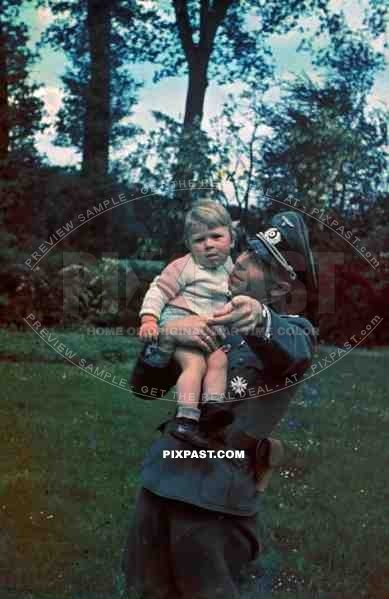
World War II German Cavalry Officer with Child, Frankfurt 1940
Add to cart -
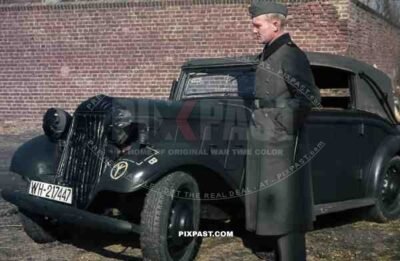
Wehrmacht Soldier Standing Beside 1938 Adler 2 Liter Cabriolet in Niederaußem, Germany 1940
Add to cart -
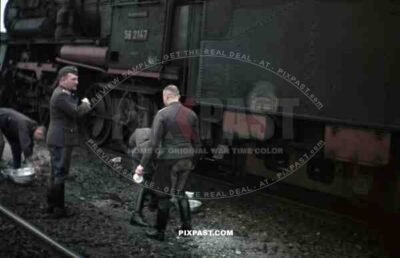
Luftwaffe Personnel Washing Dishes beside German Steam Locomotive Class 52, circa 1940
Add to cart -
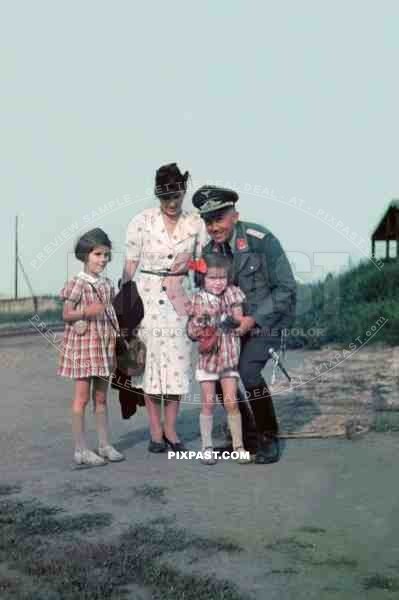
Germany Thuringen 1940 German Luftwaffe FLAK Officer in Uniform with Family
Add to cart