
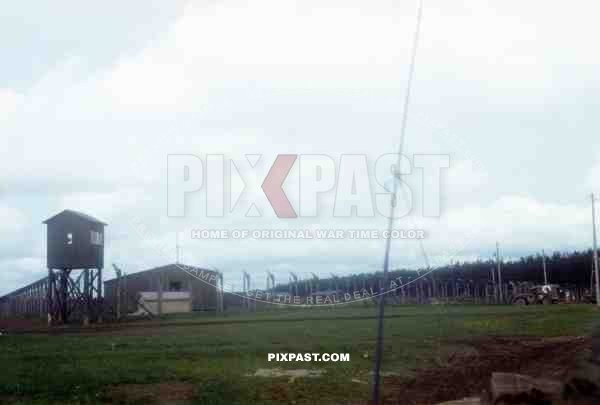
Troops of the US 101st Cavalry Regiment Arriving at Landsberg Concentration Camp, Germany, 1945
Digital Download Only: Upon purchase and successful payment, you will receive the selected image as a high-resolution JPG digital download. No physical photographs or printed copies are included in this transaction.
File details: JPG • 5,000 × 3,377 pixels
Troops of the US 101st Cavalry Regiment Arriving at Landsberg Concentration Camp, Germany, 1945
Description
This original color photograph shows a scene at Landsberg Concentration Camp in Germany, capturing the arrival of U.S. troops from the 101st Cavalry Regiment in 1945. The image features a guard tower, barbed wire fencing, and buildings related to the camp. The setting appears to be a former concentration camp that had been dismantled or secured after liberation. In the background, a military jeep and several trees are visible beyond the perimeter fence. The photo captures a significant moment near the end of World War II in Europe, highlighting the arrival of American forces assigned to secure and liberate such sites. The archive associates the image with Colonel Leslie Crozier Wood of the 101st Mechanized Cavalry Regiment. The photograph is an Agfacolor German slide, reflecting the wartime imaging technology of the period.
Dieses Original-Farbfoto zeigt eine Szene im Konzentrationslager Landsberg in Deutschland und die Ankunft von US-Truppen des 101. Kavallerieregiments im Jahr 1945. Das Bild zeigt einen Wachturm, Stacheldrahtzäune und Gebäude, die mit dem Lager verbunden sind. Die Aufnahme zeigt ein ehemaliges Konzentrationslager, das nach der Befreiung gesichert oder aufgelöst wurde. Im Hintergrund sind ein Militärjeep und Bäume hinter dem Zaun zu sehen. Das Foto dokumentiert einen bedeutenden Moment am Ende des Zweiten Weltkriegs in Europa und die Ankunft amerikanischer Streitkräfte, die für die Sicherung und Befreiung solcher Orte verantwortlich waren. Die Identität von Colonel Leslie Crozier Wood vom 101. mechanisierten Kavallerieregiment ist im Archivkontext vermerkt. Die Fotografie stammt von einem deutschen Agfacolor-Dia, was mit der Bildtechnik der Kriegszeit übereinstimmt.
Related products
-
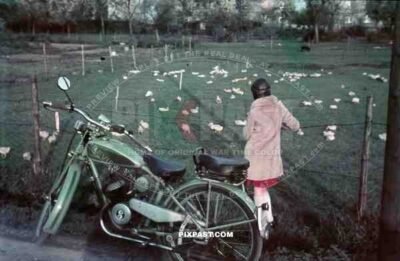
Woman in Red Skirt and Leather Helmet with Motorcycle Watching Ducks in Bremerhaven, Germany, 1939
Add to cart -
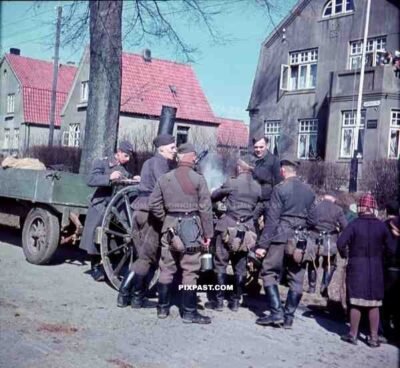
German Luftwaffe Flak Troops Eating Lunch at Mobile Field Kitchen in Norway Winter 1941
Add to cart -
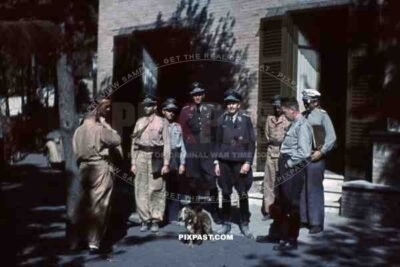
German Luftwaffe Officers Meeting for Strategy in Sicily, 1943
Add to cart -
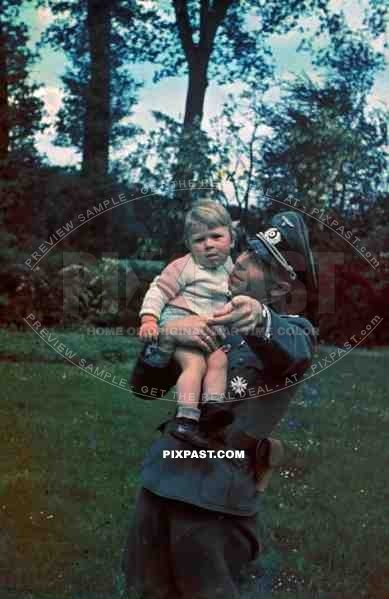
World War II German Cavalry Officer with Child, Frankfurt 1940
Add to cart