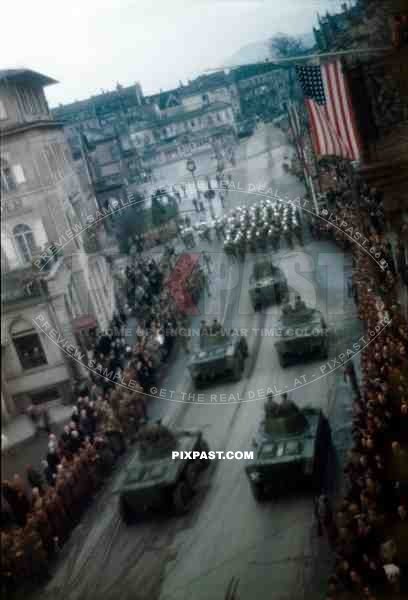
Military Funeral Procession with American Half-Tracks in Heidelberg, Germany 1945
Digital Download Only: Upon purchase and successful payment, you will receive the selected image as a high-resolution JPG digital download. No physical photographs or printed copies are included in this transaction.
File details: JPG • 3,404 × 5,000 pixels
Military Funeral Procession with American Half-Tracks in Heidelberg, Germany 1945
Description
This color photograph shows a military funeral procession in Heidelberg, Germany, in 1945. The archive identifies it as the funeral of American General George S. Patton. The procession moves along a street lined with crowds on both sides. Four American half-track armored personnel carriers travel in formation, carrying coffins draped with American flags.
A military band dressed in white uniforms marches ahead of the vehicles. An American flag hangs prominently from a building on the right side. The architecture and uniforms reflect the period immediately following World War II, supporting the historical context and location. Archive notes mention Colonel Leslie Crozier Wood and the 101st Mechanized Cavalry Regiment in connection with this event. The image is an original Agfacolor slide, preserving this historic moment in true color.
Dieses Farbfoto zeigt eine militärische Trauerprozession in Heidelberg, Deutschland, im Jahr 1945, identifiziert im Archiv als die Beerdigung des amerikanischen Generals George S. Patton. Die Prozession bewegt sich entlang einer von Menschenmengen gesäumten Straße. Auffällig sind vier amerikanische Halbkettenfahrzeuge, die in Formation fahren und scheinbar mit amerikanischen Flaggen bedeckte Särge transportieren. Eine Militärkapelle in weißen Uniformen marschiert vor den Fahrzeugen. Eine amerikanische Flagge hängt deutlich sichtbar an einem Gebäude auf der rechten Seite. Der historische Kontext und die Architektur stimmen mit der Zeit unmittelbar nach dem Zweiten Weltkrieg überein. Im Archiv werden Oberst Leslie Crozier Wood und das 101. Mechanisierte Kavallerieregiment mit diesem Ereignis in Verbindung gebracht. Das Bild scheint eine originale Agfacolor-Dias zu sein, das den historischen Moment in natürlichen Farben festhält.