
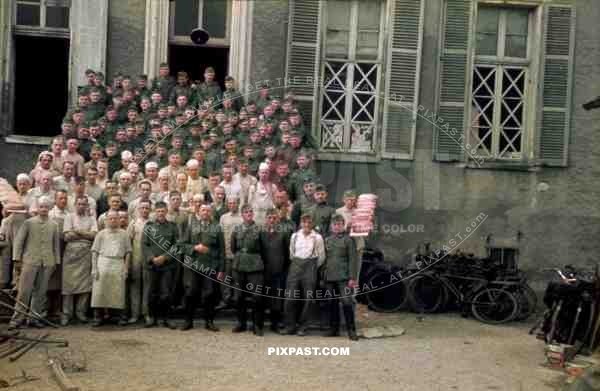
Staff Portrait of the German 290th Infantry Division Baking Company in France 1940
Digital Download Only: Upon purchase and successful payment, you will receive the selected image as a high-resolution JPG digital download. No physical photographs or printed copies are included in this transaction.
File details: JPG • 5,000 × 3,263 pixels
Staff Portrait of the German 290th Infantry Division Baking Company in France 1940
Description
This original color photograph is a staff portrait of the German 290th Infantry Division Baking Company (Backerei-Komp. 290 I.D.) taken in France in 1940 during World War II. It shows a large group of German soldiers and personnel arranged on the steps and in front of a building, likely their baking company quarters or a field kitchen. Many men wear German military uniforms typical of the 1940 period, while some personnel in front appear to be bakers or civilian support staff, identifiable by their white aprons and attire. Several bicycles rest on the side, commonly used for transport by German infantry units. The photograph is in Agfacolor, an early color photographic process employed by the Germans during WWII. The setting aligns with a wartime field location in occupied France.
Dieses Original-Farbfoto zeigt ein Mannschaftsporträt der deutschen 290. Infanteriedivision Bäckereikompanie (Backerei-Komp. 290 I.D.), aufgenommen 1940 in Frankreich während des Zweiten Weltkriegs. Das Bild zeigt eine große Gruppe deutscher Soldaten und Mitarbeiter, die auf den Stufen und vor einem Gebäude aufgestellt sind, vermutlich die Unterkünfte oder Feldküche der Bäckereikompanie. Viele Männer tragen deutsche Militäruniformen, wie sie typisch für das Jahr 1940 waren, während einige Mitarbeiter im Vordergrund Bäcker oder zivile Hilfskräfte sind, erkennbar an ihren weißen Schürzen und Kleidung. An der Seite sind mehrere Fahrräder zu sehen, die von deutschen Infanterieeinheiten häufig als Transportmittel genutzt wurden. Das Foto wurde in Agfacolor aufgenommen, einem frühen Farbverfahren der Deutschen im Zweiten Weltkrieg. Der Standort entspricht einer Kriegsschauplatz in besetztem Frankreich.
Related products
-
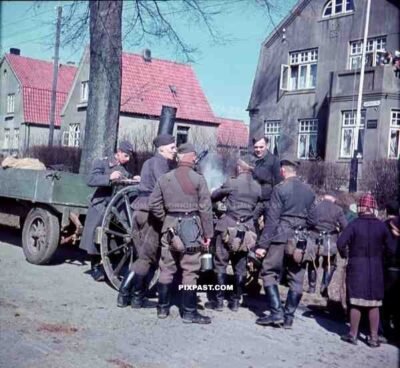
German Luftwaffe Flak Troops Eating Lunch at Mobile Field Kitchen in Norway Winter 1941
Choose Licence -
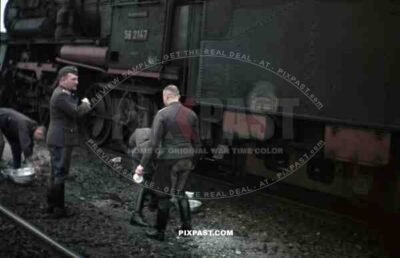
Luftwaffe Personnel Washing Dishes beside German Steam Locomotive Class 52, circa 1940
Choose Licence -
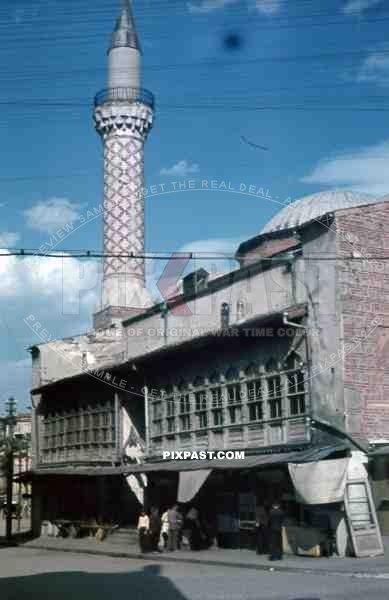
Dzhumaya Mosque and Market Buildings in Plovdiv, Bulgaria 1942
Choose Licence -
Woman in Red Skirt and Leather Helmet with Motorcycle Watching Ducks in Bremerhaven, Germany, 1939
Choose Licence