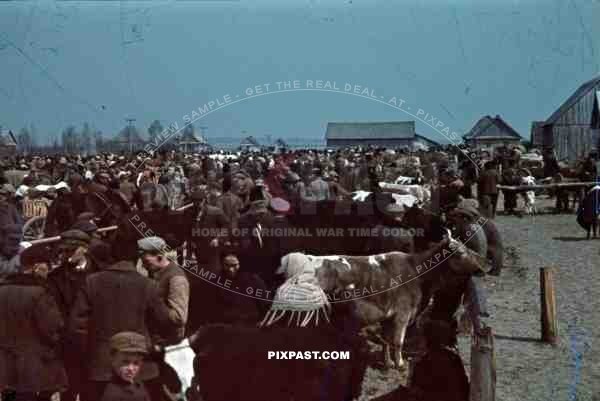
Farmers’ Market with Cattle in Eastern Europe, 1941
Digital Download Only: Upon purchase and successful payment, you will receive the selected image as a high-resolution JPG digital download. No physical photographs or printed copies are included in this transaction.
File details: JPG • 5,000 × 3,342 pixels
Farmers' Market with Cattle in Eastern Europe, 1941
Description
This color photograph shows a crowded farmers' market scene featuring mostly cattle for sale or trade, dated 1941. The market is outdoors, with numerous people—mostly peasants dressed in period rural clothing—mingling among the livestock. Wooden farm buildings and fences appear in the background beneath a clear blue sky.
Though the original filename suggests the image might depict a "Russian farmers market, 1941," archive context and visual clues align better with a rural market in Eastern Europe, specifically Turobin, Poland, in 1941. The traditional Eastern European clothing and building styles support this identification. No motor vehicles or mechanized transport are visible to aid further location. This photograph offers valuable insight into rural agricultural life in wartime Eastern Europe, capturing local farming community activity and livestock commerce.
To kolorowe zdjęcie przedstawia zatłoczony targ rolniczy, na którym głównie sprzedawane lub wymieniane są bydło, datowane na 1941 rok. Targ odbywa się na otwartym powietrzu, gdzie liczne osoby, głównie chłopi w tradycyjnym wiejskim ubraniu z tamtego okresu, przemieszczają się wśród zwierząt hodowlanych. W tle widoczne są drewniane budynki gospodarcze i ogrodzenia pod czystym, niebieskim niebem. Oryginalna nazwa pliku sugeruje "rosyjski targ rolniczy, 1941", ale kontekst archiwalny i widoczne cechy bardziej pasują do targu na wsi w Europie Wschodniej, konkretnie w Turobinie w Polsce, w 1941 roku. Obecność tradycyjnego stroju wschodnioeuropejskiego oraz styl budynków potwierdzają tę lokalizację. Żadne pojazdy mechaniczne nie są widoczne, co ogranicza dalszą identyfikację. Zdjęcie jest cennym świadectwem życia rolniczego na wsi w czasie wojny w Europie Wschodniej, ukazując lokalną społeczność rolniczą i handel bydłem.