
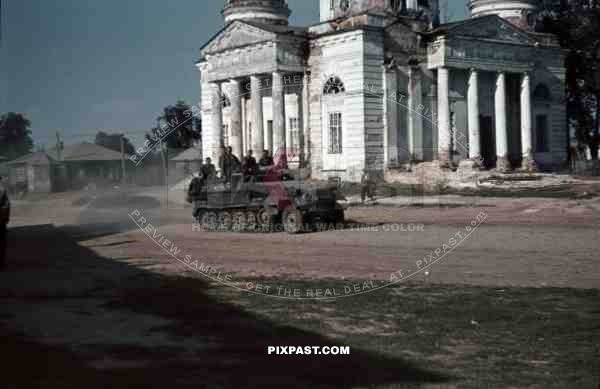
Sd.Kfz. 251 Half-track Passing Dormition Cathedral in Mglin, August 1941
Digital Download Only: Upon purchase and successful payment, you will receive the selected image as a high-resolution JPG digital download. No physical photographs or printed copies are included in this transaction.
File details: JPG • 5,000 × 3,245 pixels
Sd.Kfz. 251 Half-track Passing Dormition Cathedral in Mglin, August 1941
Description
This original color photograph shows a German Sd.Kfz. 251 half-track in front of the Dormition Cathedral in Mglin, Bryansk Oblast, Russia. It dates to August 1941 during the Eastern Front conflict of World War II. The half-track travels along a dusty road near the cathedral, which stands out with its neoclassical columns and deteriorated facade.
The scene aligns with the historical operations of the German 3rd Panzer Division in this region, part of Army Group South under Army Group Guderian. This vehicle served as an armored personnel carrier, commonly used by German forces to transport troops. The photograph is a rare example of wartime color imagery, captured on Agfacolor film, highlighting the contrast between military machinery and cultural heritage amid wartime conditions.
Dieses Originalfarbfoto zeigt ein deutsches Sd.Kfz. 251 Halbkettenfahrzeug vor der Auferstehungskathedrale in Mglin, Oblast Brjansk, Russland, datiert auf August 1941 während des Ostfront-Konflikts im Zweiten Weltkrieg. Der Halbkettenschlepper fährt eine staubige Straße nahe der Kathedrale entlang, die mit ihren neoklassizistischen Säulen und dem beschädigten Äußeren deutlich zu sehen ist. Das Foto entspricht dem historischen Kontext der Operationen der deutschen 3. Panzerdivision in dieser Region im Rahmen der Heeresgruppe Süd unter Heeresgruppe Guderian. Das Fahrzeug ist ein gepanzerter Mannschaftstransporter, der häufig von deutschen Streitkräften zum Truppentransport verwendet wurde. Das Bild ist ein seltenes Beispiel für Farbfotografie im Zweiten Weltkrieg mit Agfacolor-Film und zeigt den Kontrast zwischen militärischer Technik und kulturellem Erbe unter Kriegsbedingungen.
Related products
-
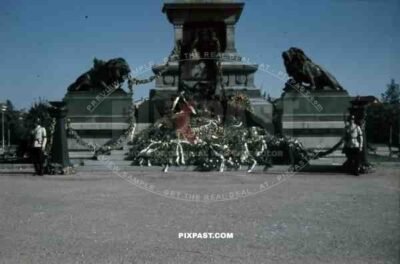
Liberty Monument in Ruse, Bulgaria, 1943
Add to cart -
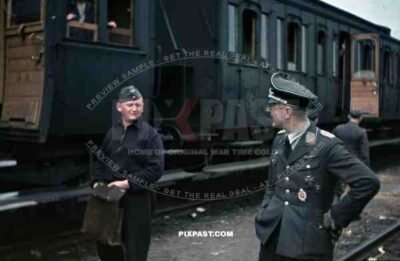
Luftwaffe Pilot with Awards at Railway Yard, Stendal, Germany, 1940
Add to cart -
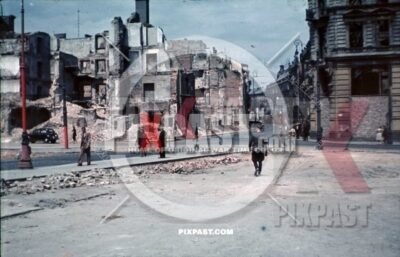
WW2 Color Photograph of Luftwaffe Officer Bindewald in Bombed Krakow, Poland, 1940
Add to cart -
German Luftwaffe Officers Meeting for Strategy in Sicily, 1943
Add to cart