
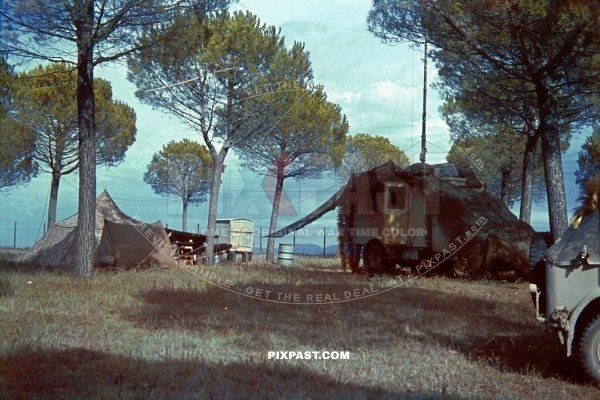
German Ramcke Division Radio Truck in Field Camp near Rome, Italy 1943
Digital Download Only: Upon purchase and successful payment, you will receive the selected image as a high-resolution JPG digital download. No physical photographs or printed copies are included in this transaction.
File details: JPG • 5,000 × 3,333 pixels
German Ramcke Division Radio Truck in Field Camp near Rome, Italy 1943
Description
This original color photograph shows a German military field camp set up near Rome, Italy, in 1943, likely during or shortly after Operation Achse in World War II. A German radio communication truck with a tall antenna stands among scattered pine trees. Several canvas tents are pitched close to the truck, which appears to belong to the Ramcke Division, a well-known German paratrooper unit. On the right edge, part of another military vehicle is partially visible. The rural landscape suggests a temporary command or communication post. The filename "ramcke-rome-1943-f" and archive context support the identification of the place and date. The truck’s exact model cannot be conclusively identified but matches German military radio trucks of the early 1940s. The use of Agfacolor film adds authentic contemporary color detail to the scene.
Diese Originalfarbfotografie zeigt ein deutsches Militärlager in der Nähe von Rom, Italien, im Jahr 1943, vermutlich während oder kurz nach der Operation Achse im Zweiten Weltkrieg. Das Bild zeigt einen deutschen Funkwagen mit hoher Antenne, stationiert zwischen verstreuten Pinien. Mehrere Zelte aus Segeltuch sind in der Nähe des Fahrzeugs aufgebaut, das offenbar zur Ramcke-Division gehört, einer bekannten deutschen Fallschirmjägereinheit. Am rechten Bildrand ist ein weiteres Militärfahrzeug teilweise zu sehen. Die Umgebung ist ländlich, was auf einen temporären Kommandoposten hindeutet. Der Dateiname „ramcke-rome-1943-f“ und der Archivkontext bestätigen Ort und Datum. Das genaue Modell des Funkwagens lässt sich aus diesem Bild nicht sicher bestimmen, entspricht jedoch deutschen Militär-Funkwagen der frühen 1940er Jahre. Die Verwendung von Agfacolor-Film verleiht der Szene authentische zeitgenössische Farbdarstellung.
Related products
-
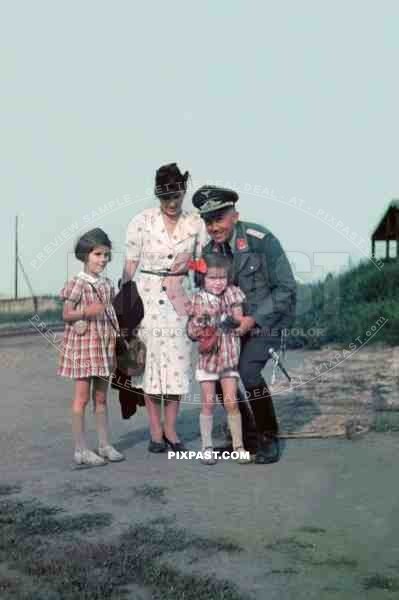
Germany Thuringen 1940 German Luftwaffe FLAK Officer in Uniform with Family
Add to cart -
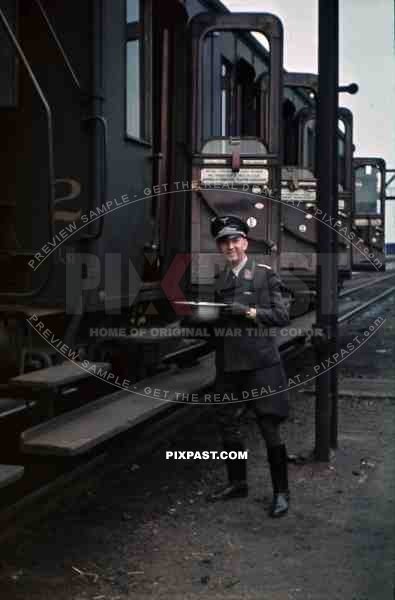
Luftwaffe Officer at Railway Carriage in Stendal, Germany, 1940
Add to cart -
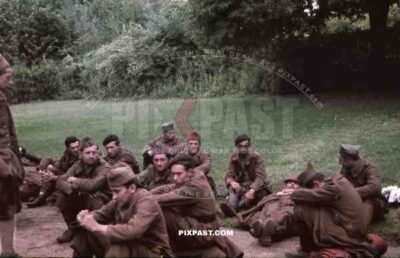
French Army POW Soldiers Near Verdun, France, 1940
Add to cart -
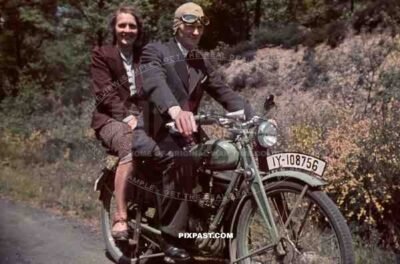
Bremerhaven 1939 NSU Motorcycle with Riding License IY-108756, Helmet and Goggles
Add to cart