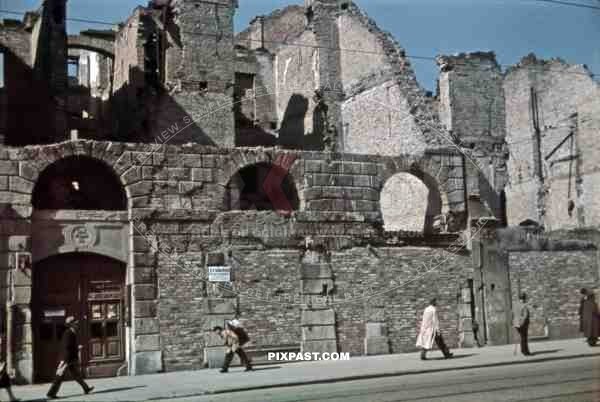
Ruined Buildings on Nowy Świat Street in Warsaw, Poland, 1939
Digital Download Only: Upon purchase and successful payment, you will receive the selected image as a high-resolution JPG digital download. No physical photographs or printed copies are included in this transaction.
File details: JPG • 5,000 × 3,356 pixels
Ruined Buildings on Nowy Świat Street in Warsaw, Poland, 1939
Description
This historical color photograph shows the severely damaged facade and ruined upper floors of buildings at Nowy Świat 53 in Warsaw, Poland, in 1939. The partially destroyed walls reveal exposed brickwork, and missing roofs suggest wartime destruction, likely from bombing or artillery during the early phase of World War II. A few pedestrians walk past the ruins along a street with visible tram tracks, highlighting the urban setting amid the conflict’s aftermath. The image captures a poignant moment, reflecting the scale of destruction in Warsaw during the invasion. No identifiable vehicles or specific models appear in the scene. The photograph is an Agfacolor slide, consistent with German photographic technology of the time, while the setting and damage correspond to Polish urban architecture. The original filename (2006989) provides no direct location or date details, but archive context confirms the site and year as Nowy Świat, Warsaw, Poland, 1939.
To historyczne kolorowe zdjęcie pokazuje poważnie uszkodzony front oraz zrujnowane górne kondygnacje budynków przy ulicy Nowy Świat 53 w Warszawie, Polska, w 1939 roku. Widoczne są częściowo zniszczone ściany z odsłoniętą cegłą i brakujące dachy, co wskazuje na zniszczenia wojenne, prawdopodobnie spowodowane bombardowaniem lub ostrzałem artyleryjskim w początkowej fazie II wojny światowej. Kilka osób spaceruje wzdłuż ulicy, na której widoczne są tory tramwajowe, podkreślając miejski charakter miejsca w kontekście wojennych zniszczeń. Obraz ukazuje wymowny moment odzwierciedlający skalę zniszczeń Warszawy podczas okresu inwazji. Nie widoczne są żadne rozpoznawalne pojazdy ani modele. Fotografia jest slajdem Agfacolor, co odpowiada niemieckiej technologii fotograficznej tamtego okresu, ale sceneria i zniszczenia korespondują z polską architekturą miejską.