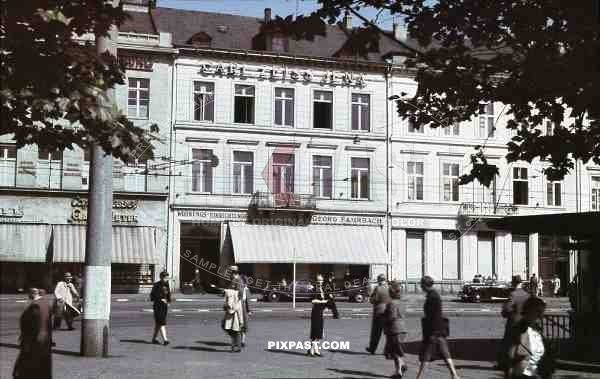
Neumarkt Square in Cologne, Germany, 1940 with Carl Zeiss Jena Shopfront
Digital Download Only: Upon purchase and successful payment, you will receive the selected image as a high-resolution JPG digital download. No physical photographs or printed copies are included in this transaction.
File details: JPG • 5,000 × 3,160 pixels
Neumarkt Square in Cologne, Germany, 1940 with Carl Zeiss Jena Shopfront
Description
This original color photograph shows Neumarkt Square in Cologne, Germany, in 1940. The central focus is a building with prominent signage reading "Carl Zeiss Jena," indicating a shop or office linked to the famous optics manufacturer from Jena, Germany. Below this sign, another reads "Georg Fahrbach," likely naming the proprietor or related business.
Several pedestrians, mostly women, walk or stand in the foreground. The architecture reflects typical early 20th-century German urban design, featuring three stories, large windows, and decorative details. A number of cars, consistent with late 1930s to early 1940s European passenger models, are parked in front of the building.
The scene captures a peaceful urban street during wartime Germany, as noted by the 1940 date and Agfacolor slide medium. This photograph offers valuable visual documentation of civilian life and commercial architecture in Cologne at that time.
Dieses originale Farbfoto zeigt den Neumarkt in Köln, Deutschland, im Jahr 1940. Im Mittelpunkt steht das Gebäude mit der prominenten Aufschrift „Carl Zeiss Jena“, was auf ein Geschäft oder Büro des bekannten Optikherstellers Carl Zeiss aus Jena hinweist. Unter dem Hauptzeichen befindet sich ein weiteres Schild mit der Aufschrift „Georg Fahrbach“, vermutlich der Inhaber oder damit verbundenes Geschäft. Im Vordergrund sind mehrere Fußgängerinnen zu sehen, die gehen oder stehen. Die Architektur entspricht den städtischen Gebäuden Deutschlands aus dem frühen 20. Jahrhundert mit drei Stockwerken, großen Fenstern und dekorativen Details. Zahlreiche Autos, die dem späten 1930er bis frühen 1940er Jahre entsprechen, sind vor dem Gebäude geparkt. Die Szene zeigt eine friedliche Straßenszene im Kriegsgeschehen, wie das Datum 1940 und das Agfacolor-Dia belegen. Das Foto bietet wertvolle visuelle Dokumentation des zivilen Lebens und der Architektur Kölns in dieser Zeit.