Motorized Infantry of the 13. Panzer Division with Stoewer Typ 40 Kfz.1 Jeeps, Rostov-on-Don 1942
Digital Download Only: Upon purchase and successful payment, you will receive the selected image as a high-resolution JPG digital download. No physical photographs or printed copies are included in this transaction.
File details: JPG • 5,000 × 3,338 pixels
Motorized Infantry of the 13. Panzer Division with Stoewer Typ 40 Kfz.1 Jeeps, Rostov-on-Don 1942
Description
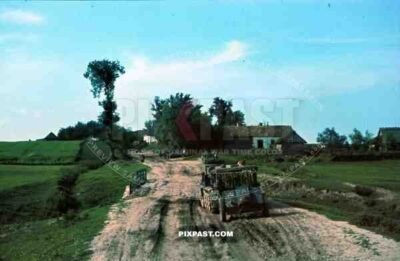
This original color photograph shows motorized infantry of the German 13. Panzer Division resting beside a line of Stoewer Typ 40 Kfz.1 light military vehicles or jeeps. It was taken in Rostov-on-Don, Russia, in July 1942, matching the 13. Panzer Division’s known activities on the Eastern Front during World War II. The vehicles display the characteristic flat, open-top bodies and utilitarian military fittings typical of the Stoewer Typ 40 models produced before and early in the war. The rural roadside setting, under a partly cloudy sky, highlights the wartime mobility of this motorized infantry unit. Soldiers appear near and inside the vehicles, resting during a campaign phase. This rare color image provides valuable visual documentation of German armored troops and Wehrmacht field operations in 1942.
Dieses Originalfarbfoto zeigt motorisierte Infanterieeinheiten der deutschen 13. Panzer-Division im Sommer 1942, die neben einer Reihe von Stoewer Typ 40 Kfz.1 leichten Militärfahrzeugen oder Jeeps ruhen. Der Ort ist als Rostow am Don, Russland, im Juli 1942 identifiziert, was mit den bekannten Operationen der 13. Panzer-Division an der Ostfront im Zweiten Weltkrieg übereinstimmt. Die Fahrzeuge zeigen charakteristische flache, offene Karosserien mit utilitaristischen militärischen Ausstattungen, die typisch für den vor und während der frühen Kriegsjahre produzierten Stoewer Typ 40 sind. Die natürliche Umgebung zeigt eine ländliche Straße mit teilweise bewölktem Himmel, was die Mobilität dieser motorisierten Infanterieeinheit verdeutlicht. Die Soldaten sind in und um die Fahrzeuge sichtbar und ruhen sich während einer Kampagnenphase aus. Das Bild ist eine seltene Farbaufnahme deutscher gepanzerter Truppen aus dieser Zeit und trägt zur visuellen Dokumentation der Wehrmachtsfeldoperationen 1942 bei.