
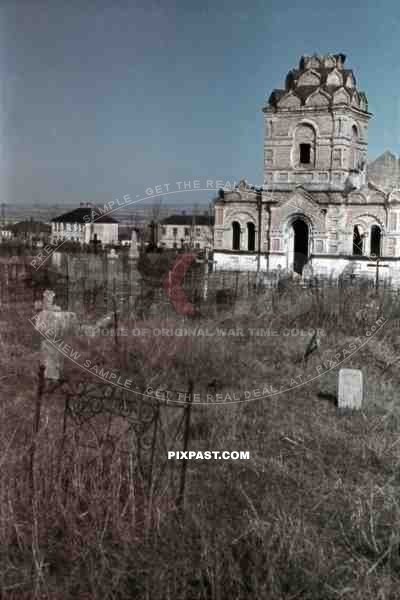
Lazarevskaya Church Ruin and Sevastopol Cemetery, Crimea, 1941
Digital Download Only: Upon purchase and successful payment, you will receive the selected image as a high-resolution JPG digital download. No physical photographs or printed copies are included in this transaction.
File details: JPG • 3,336 × 5,000 pixels
Lazarevskaya Church Ruin and Sevastopol Cemetery, Crimea, 1941
Description
This original historical color photograph, dated 1941, shows the ruin of the Lazarevskaya Church next to a cemetery in Sevastopol, Crimea. The church appears damaged, reflecting the wartime destruction in the region during World War II. Gravestones lie scattered across overgrown grass, suggesting a neglected or war-affected cemetery. In the background, low buildings and a clear sky provide context to the location in Sevastopol.
The photograph was taken during the German military presence around 1940-1941, using Agfacolor film, one of the color photographic materials available at the time. No vehicles or transport appear in the image. The filename, "2011907," offers no additional identifiable metadata. Archive research confirms the location and date but notes some uncertainty, as this identification relies on prior owner input and visible matching.
Dieses originale Farbphoto aus dem Archiv zeigt die Ruine der Lazarevskaya-Kirche neben einem Friedhof in Sewastopol, Krim, datiert auf 1941. Die Kirche ist beschädigt, was die Kriegszerstörungen in der Region während des Zweiten Weltkriegs widerspiegelt. Man sieht verstreute Grabsteine auf überwachstem Gras, was auf einen vernachlässigten oder kriegsbetroffenen Friedhof hinweist. Im Hintergrund sind niedrige Gebäude und ein klarer Himmel zu erkennen, was den Standort Sewastopol bestätigt. Das Foto entstand im Zusammenhang mit der deutschen Militärpräsenz um 1940-1941 und wurde mit Agfacolor-Film aufgenommen, einem der damals verfügbaren Farbfilmmaterialien. Fahrzeuge oder Transportmittel sind auf dem Bild nicht zu sehen. Der Dateiname '2011907' bietet keine weiteren erkennbaren Metadaten. Die Archivrecherche bestätigt Standort und Datum, weist aber auf gewisse Unsicherheiten hin, da diese Identifikation auf früheren Angaben des Besitzers und sichtbarer Übereinstimmung beruht.
Related products
-
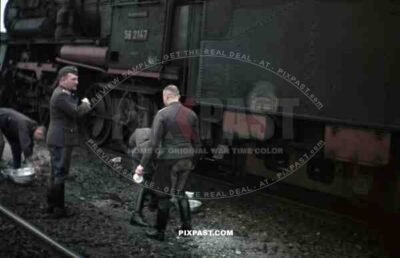
Luftwaffe Personnel Washing Dishes beside German Steam Locomotive Class 52, circa 1940
Add to cart -
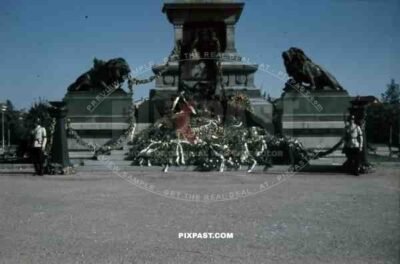
Liberty Monument in Ruse, Bulgaria, 1943
Add to cart -
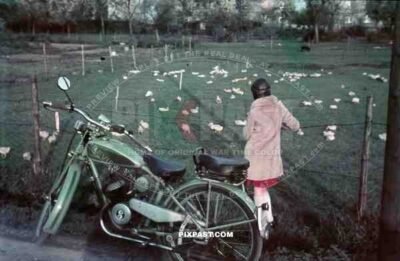
Woman in Red Skirt and Leather Helmet with Motorcycle Watching Ducks in Bremerhaven, Germany, 1939
Add to cart -
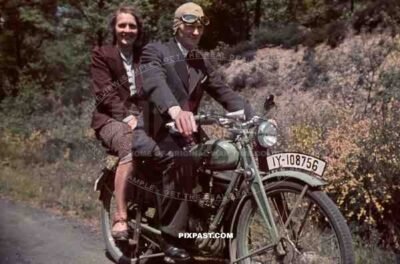
Bremerhaven 1939 NSU Motorcycle with Riding License IY-108756, Helmet and Goggles
Add to cart