
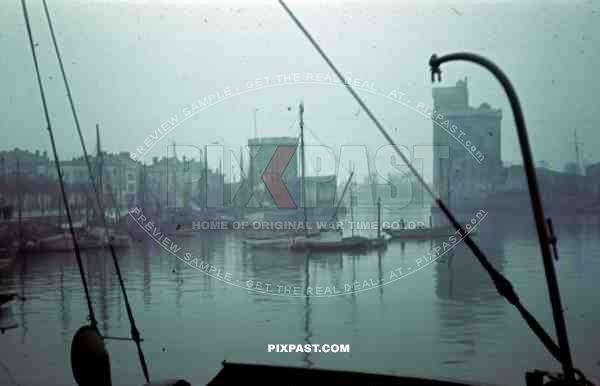
La Rochelle harbour with tower St.-Nicolas and tower de la Chaine, France, 1941
Digital Download Only: Upon purchase and successful payment, you will receive the selected image as a high-resolution JPG digital download. No physical photographs or printed copies are included in this transaction.
File details: JPG • 5,000 × 3,218 pixels
La Rochelle harbour with tower St.-Nicolas and tower de la Chaine, France, 1941
Description
This historical photograph shows the harbour of La Rochelle, a coastal city in western France, captured in 1941. The scene features the harbour waters with several moored sailing boats and ships. Prominently visible are the medieval defensive towers: the tower Saint-Nicolas on the left and the tower de la Chaine on the right, guarding the entrance to the old harbour.
The overcast sky and calm waters create a subdued atmosphere typical of wartime Europe. Based on the filename and archive context, the image reflects a German perspective during World War II, specifically in 1941. No military vehicles or personnel are visible to confirm the presence of the 22nd Panzer Division, although the archive notes mention it. The photo was taken with agfacolor film, producing muted yet authentic color tones from that era.
Cette photographie historique montre le port de La Rochelle, une ville côtière de l'ouest de la France, prise en 1941. On y voit le bassin portuaire avec plusieurs voiliers et bateaux amarrés. Sont notamment visibles les tours médiévales défensives : la tour Saint-Nicolas à gauche et la tour de la Chaîne à droite, qui gardent l'entrée du vieux port. Le ciel couvert et l'eau calme donnent une atmosphère discrète typique de l'Europe en temps de guerre. D'après le nom de fichier et le contexte d'archive, cette image est issue d'une perspective allemande pendant la Seconde Guerre mondiale, en 1941. Aucun véhicule militaire ni personnel identifiable n'est visible sur la photo pour confirmer la présence de la 22e division Panzer, bien que le contexte d'archive la mentionne. La photo a été prise avec un film agfacolor, offrant des tons de couleur atténués mais authentiques de cette époque.
Related products
-
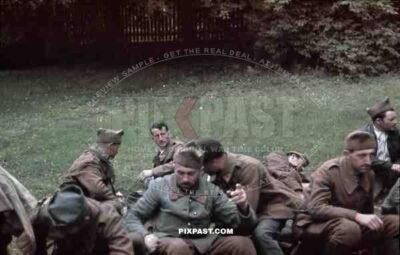
French Army POW Soldiers Near Verdun, France, 1940
Add to cart -
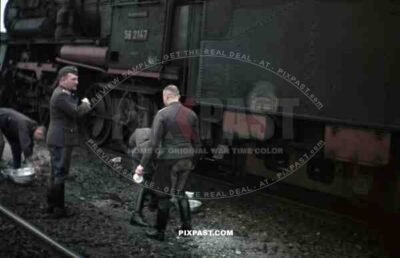
Luftwaffe Personnel Washing Dishes beside German Steam Locomotive Class 52, circa 1940
Add to cart -
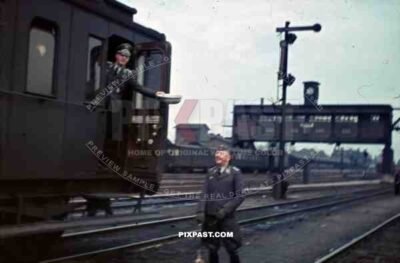
Luftwaffe Officers Cleaning Train Toilet at Stendal Railway Yard, Germany 1940
Add to cart -
World War II German Cavalry Officer with Child, Frankfurt 1940
Add to cart