
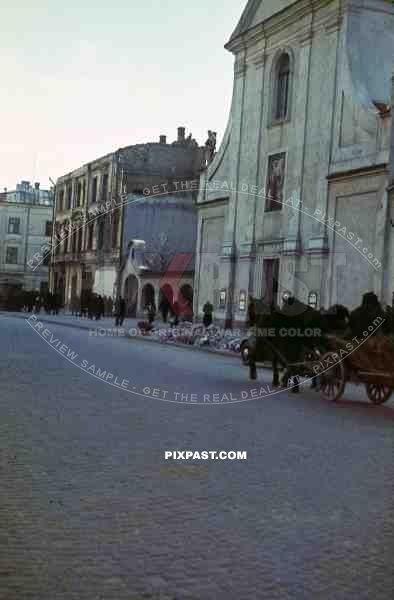
Krakowskie Przedmieście Street and Capuchin Monastery in Lublin, Poland, 1939
Digital Download Only: Upon purchase and successful payment, you will receive the selected image as a high-resolution JPG digital download. No physical photographs or printed copies are included in this transaction.
File details: JPG • 3,290 × 5,000 pixels
Krakowskie Przedmieście Street and Capuchin Monastery in Lublin, Poland, 1939
Description
This original historical color photograph shows a street scene on Krakowskie Przedmieście in Lublin, Poland, dated 1939 according to archive context and filename clues. The image centers on the Capuchin Monastery complex, recognizable by the large church facade on the right, featuring classical architectural style. Along the street, a horse-drawn carriage carries people or goods, typical of the period before widespread motor vehicle use in this area. The street is paved with cobblestones, and the buildings appear aged but well preserved. This scene captures daily life in a Polish city just before World War II, reflecting the architectural and transport features of late 1930s Poland. No modern motorized vehicles are visible in the frame. Although the archive mentions German and war-related terms, the photograph itself shows no direct military presence or conflict. Its historical value lies in documenting urban life and religious architecture in pre-war Lublin.
To oryginalne historyczne kolorowe zdjęcie przedstawia ulicę Krakowskie Przedmieście w Lublinie, Polska, z roku 1939 według kontekstu archiwalnego i wskazówek z nazwy pliku. Na zdjęciu widoczny jest kompleks klasztorny oo. Kapucynów rozpoznawalny po dużej fasadzie kościoła po prawej stronie o klasycznym stylu architektonicznym. Na ulicy widoczny jest powóz konny przewożący ludzi lub towary, co odpowiada okresowi przed powszechnym użyciem pojazdów mechanicznych w tym miejscu. Ulica jest wyłożona brukiem, a budynki wyglądają na stare, lecz nietknięte. Scena ukazuje codzienne życie w polskim mieście tuż przed II wojną światową, odzwierciedlając cechy architektoniczne i transportowe końca lat 30. XX wieku w Polsce. W kadrze nie widać nowoczesnych pojazdów mechanicznych. Choć kontekst archiwalny wspomina o Niemcach i wojnie, na zdjęciu nie ma bezpośrednich oznak wojskowej obecności ani konfliktu. Wartość historyczna polega na dokumentacji życia miejskiego i architektury sakralnej przedwojennego Lublina.
Related products
-
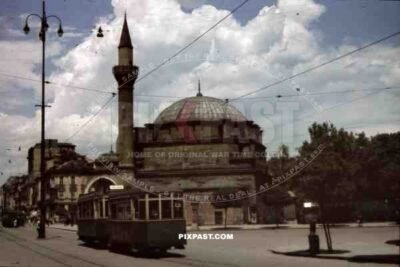
Banja-Baschi Mosque and Sofia Tram, Bulgaria 1942
Add to cart -

Luftwaffe Soldiers by Train Wagon at Stendal Railway Yard, Germany 1940
Add to cart -
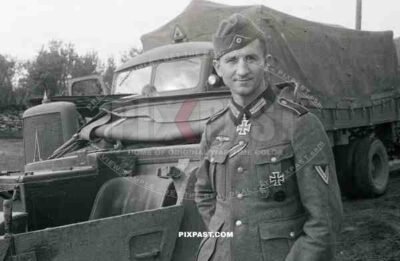
Obergefreiter Richard Gambietz with German Military Truck, Russia 1942
Add to cart -
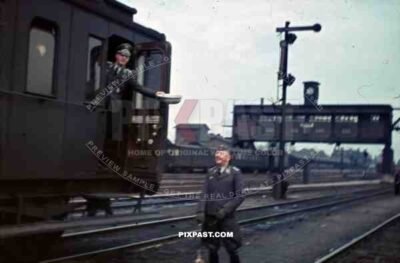
Luftwaffe Officers Cleaning Train Toilet at Stendal Railway Yard, Germany 1940
Add to cart