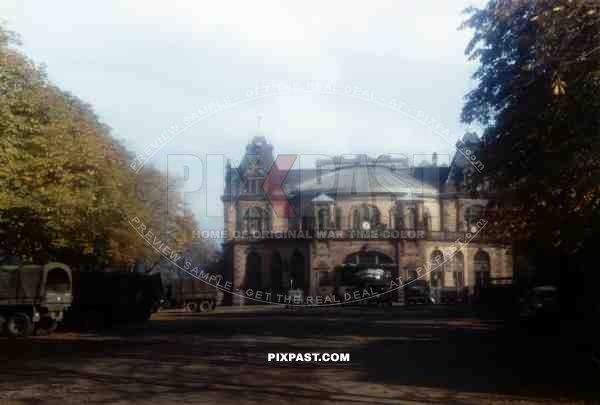
Stardust Club at Kongresshaus Stadthalle Heidelberg with 101st Cavalry Regiment Vehicles, 1945
Digital Download Only: Upon purchase and successful payment, you will receive the selected image as a high-resolution JPG digital download. No physical photographs or printed copies are included in this transaction.
File details: JPG • 5,000 × 3,383 pixels
Stardust Club at Kongresshaus Stadthalle Heidelberg with 101st Cavalry Regiment Vehicles, 1945
Description
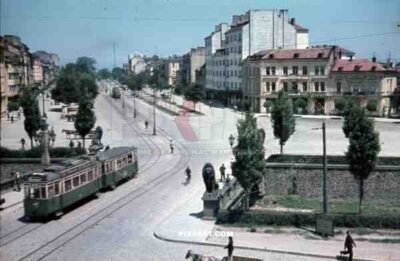
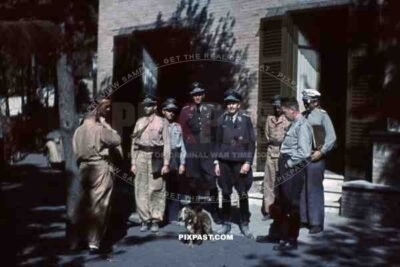
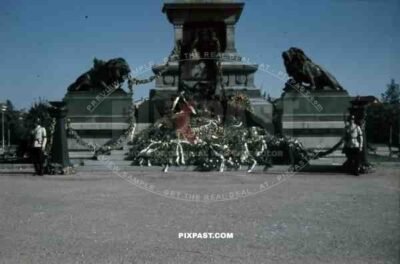
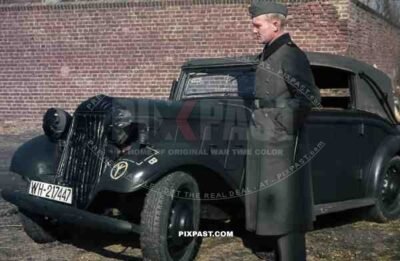
This original color photograph shows the Kongresshaus Stadthalle in Heidelberg, Germany, in 1945. The building stands at dusk or under subdued light, framed by trees on both sides. In front of the Stadthalle, several military vehicles belonging to the 101st Cavalry Regiment are visible, including a medium-sized military truck on the left. The presence of these vehicles and the regiment corresponds to the early post-World War II period in 1945, during occupation or transit. The scene likely relates to the Stardust Club, a location or event connected with the regiment. The image was captured on an Agfacolor color slide, typical of the period and German production. It documents a moment of military and civic interaction shortly after the war at a prominent civic building in Heidelberg.
Dieses originale Farbfoto zeigt das Kongresshaus Stadthalle in Heidelberg, Deutschland, im Jahr 1945. Das Gebäude ist bei Dämmerung oder schwachem Licht aufgenommen, umgeben von Bäumen auf beiden Seiten. Vor der Stadthalle stehen mehrere Militärfahrzeuge, die dem 101. Kavallerieregiment zugeordnet werden, darunter ein mittelgroßer Militär-Lkw, sichtbar auf der linken Seite. Die Fahrzeuge und die Anwesenheit des Regiments stimmen mit der Nachkriegszeit Anfang 1945 während der Besatzung oder des Transits überein. Die Szene bezieht sich wahrscheinlich auf den Stardust Club, einen Ort oder ein Ereignis, das mit dem Regiment verbunden ist. Das fotografische Medium ist eine Agfacolor-Farbdia, die der Periode und deutschen Produktion entspricht. Das Bild dokumentiert einen Moment der militärischen und zivilen Schnittstelle kurz nach dem Krieg in einem prominenten städtischen Gebäude in Heidelberg.