
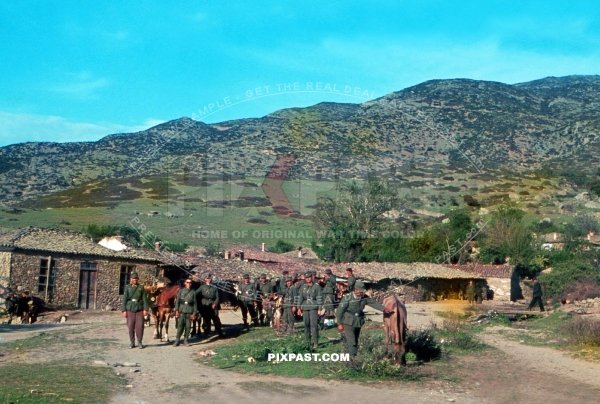
German Infantry of 304 Schützen Regiment, 2nd Panzer Division in Greek Mountain Village, 1941
Digital Download Only: Upon purchase and successful payment, you will receive the selected image as a high-resolution JPG digital download. No physical photographs or printed copies are included in this transaction.
File details: JPG • 5,000 × 3,370 pixels
German Infantry of 304 Schützen Regiment, 2nd Panzer Division in Greek Mountain Village, 1941
Description
This original color photograph shows German infantry soldiers from the 304 Schützen Regiment, part of the 2nd Panzer Division, gathered in a rural Greek mountain village during the 1941 invasion of Greece. The uniformed infantrymen stand in a loose formation alongside horses, likely used for transport in the mountainous terrain.
The village features stone buildings with tile roofs, set at the base of rocky, sparsely vegetated hills. The soldiers wear field grey uniforms and carry equipment typical of German Wehrmacht infantry and Gebirgsjäger (mountain troops) from this era. The location and date are supported by the filename clue "greece7" and archival records referencing the 1941 invasion involving the 2nd Panzer Division.
This image provides valuable insight into the logistics and daily conditions of the German mountain infantry campaign in Greece, highlighting the use of horses in rugged terrain and the traditional village architecture.
Αυτή η αυθεντική έγχρωμη φωτογραφία παρουσιάζει μια ομάδα Γερμανών πεζικάριων από το 304 Σύνταγμα Schützen, μέλος της 2ης Τεθωρακισμένης Μεραρχίας, συγκεντρωμένους σε ένα ορεινό χωριό της Ελλάδας κατά τη διάρκεια της εισβολής το 1941. Οπλισμένοι πεζικάριοι στέκονται χαλαρά με άλογα, πιθανώς για μεταφορά στο ορεινό έδαφος. Το σκηνικό είναι ένα παραδοσιακό χωριό με πέτρινα κτίρια και κεραμοσκεπές, στους πρόποδες βραχωδών, αραιοκατοικημένων λόφων. Οι στολές τους είναι τυπικές του γερμανικού στρατού και των ορεινών μονάδων (Gebirgsjäger) της εποχής. Η τοποθεσία και η ημερομηνία υποστηρίζονται από το όνομα αρχείου και το αρχειακό πλαίσιο που αναφέρονται στην εισβολή του 1941 από τη 2η Τεθωρακισμένη Μεραρχία. Η εικόνα αποτυπώνει τη ζωή και τις συνθήκες του γερμανικού ορεινού πεζικού στην Ελλάδα, με την χρήση αλόγων και παραδοσιακής αρχιτεκτονικής.
Related products
-
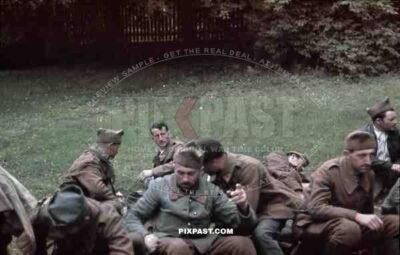
French Army POW Soldiers Near Verdun, France, 1940
Add to cart -
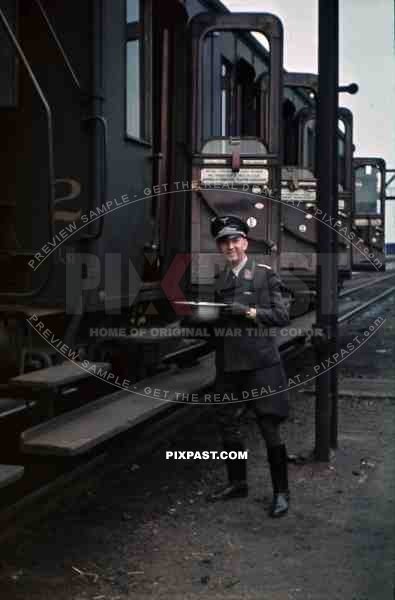
Luftwaffe Officer at Railway Carriage in Stendal, Germany, 1940
Add to cart -

Luftwaffe Soldiers by Train Wagon at Stendal Railway Yard, Germany 1940
Add to cart -
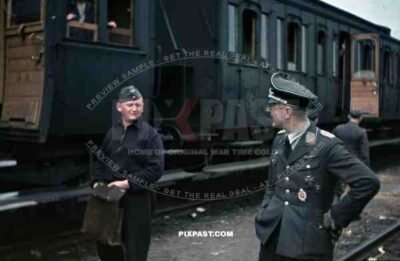
Luftwaffe Pilot with Awards at Railway Yard, Stendal, Germany, 1940
Add to cart