
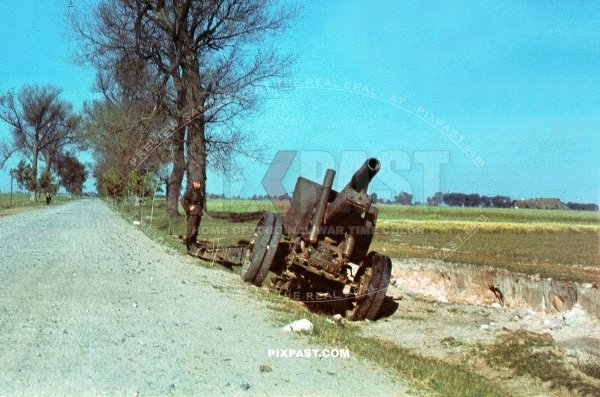
Captured Soviet 122 mm Howitzer M1931 (A-19) at Russian Front, Orel 1942
Digital Download Only: Upon purchase and successful payment, you will receive the selected image as a high-resolution JPG digital download. No physical photographs or printed copies are included in this transaction.
File details: JPG • 5,000 × 3,312 pixels
Captured Soviet 122 mm Howitzer M1931 (A-19) at Russian Front, Orel 1942
Description
This original color photograph shows a captured Soviet heavy artillery piece, a 122 mm Howitzer M1931 (also known as the A-19), positioned beside a rural road during the 1942 conflict near Orel on the Russian front. The gun is partially embedded at an angle on the roadside, displaying its large wheels and barrel typical of Soviet design from that period. A soldier stands nearby, providing scale and context to the scene. The image offers a rare color view of World War II Eastern Front equipment and battlefield conditions, with a clear blue sky and sparse trees lining the road. Its historical significance lies in the capture of this artillery by German forces during the intense fighting around the Orel region in 1942. The agfacolor processing identifies it as a wartime German color slide, enhancing its archival value.
Dieses Originalfarbfoto zeigt ein erbeutetes sowjetisches schweres Geschütz, ein 122-mm-Haubitze M1931 (auch bekannt als A-19), das neben einer Landstraße während des Konflikts 1942 an der russischen Front bei Orel positioniert ist. Die Kanone, die teilweise schräg am Straßenrand verankert ist, zeigt ihre großen Räder und den Lauf, typisch für das sowjetische Design dieser Zeit. Ein Soldat steht daneben und gibt dem Bild Maßstab und Kontext. Das Bild bietet eine seltene Farbsicht auf Ausrüstung und Schlachtfeldbedingungen an der Ostfront im Zweiten Weltkrieg, mit klarem blauem Himmel und wenigen Bäumen entlang der Straße. Die historische Bedeutung liegt in der Erbeutung solcher Artillerie durch deutsche Truppen während der heftigen Kämpfe um die Region Orel 1942. Die agfacolor-Aufnahme deutet auf eine deutsche Farbfolie aus der Kriegszeit hin, was den Archivwert erhöht.
Related products
-
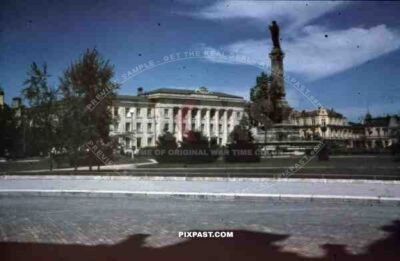
Liberty Monument and Courthouse in Ruse, Bulgaria, 1943
Add to cart -
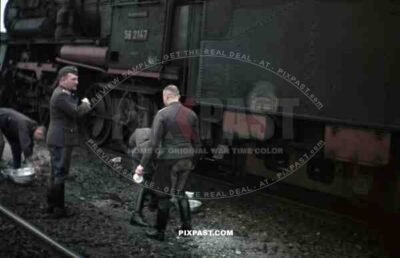
Luftwaffe Personnel Washing Dishes beside German Steam Locomotive Class 52, circa 1940
Add to cart -
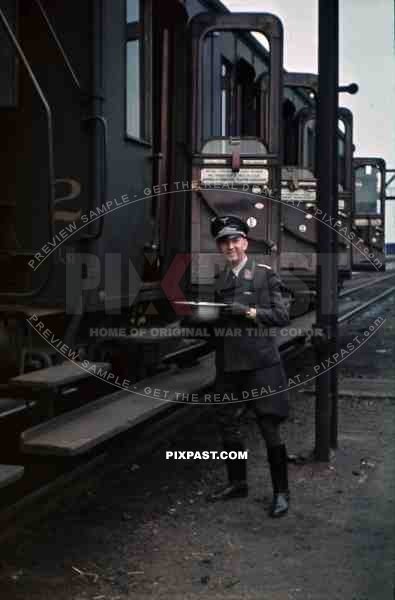
Luftwaffe Officer at Railway Carriage in Stendal, Germany, 1940
Add to cart -
French Army POW Soldiers Near Verdun, France, 1940
Add to cart