

Germany 1944 Panzer Officer in Black Tunic with Totenkopf Skull Insignia Visiting Young Child
Digital Download Only: Upon purchase and successful payment, you will receive the selected image as a high-resolution JPG digital download. No physical photographs or printed copies are included in this transaction.
File details: JPG • 5,000 × 3,134 pixels
Germany 1944 Panzer Officer in Black Tunic with Totenkopf Skull Insignia Visiting Young Child
Description
This original 1944 Agfacolor photograph from Germany shows a German Panzer officer wearing a distinctive black SS-style uniform tunic with the Totenkopf (death’s head skull) insignia on the collar. He is bending at the knees on an outdoor dirt surface, warmly engaging with a young child dressed in a white coat and light-colored shorts or dress. The officer’s uniform features pink piping, historically associated with the Panzer (armored) branch of the Waffen-SS and Wehrmacht. The moment appears to be a personal or family visit, offering a rare, humanizing glimpse of wartime figures. Although the exact location is unverified, it is consistent with Germany in 1944 during World War II. This photograph is significant for its vivid color capture of a typically monochrome subject and candid interpersonal interaction.
Dieses Originalfoto aus dem Jahr 1944 wurde in Deutschland mit Agfacolor aufgenommen und zeigt einen deutschen Panzeroffizier, der eine charakteristische schwarze SS-Uniform mit dem Totenkopf-Kragenabzeichen trägt. Er beugt sich auf einem Außenboden aus Erde zu einem kleinen Kind hinunter, das einen weißen Mantel und helle Shorts oder ein Kleid trägt. Die Uniform des Offiziers zeigt rosafarbene Paspeln, die historisch der Panzertruppe der Waffen-SS und Wehrmacht zugeordnet sind. Die Szene scheint ein persönlicher oder familiärer Besuch zu sein und bietet einen seltenen humanisierenden Einblick in Kriegsfiguren. Der Ort ist nicht verifiziert, entspricht jedoch Deutschland im Jahr 1944 während des Zweiten Weltkriegs. Das Foto ist historisch bedeutsam durch seine lebendige Farbdarstellung eines sonst meist streng monochromen Kriegsumfelds und die intime zwischenmenschliche Begegnung.
Related products
-
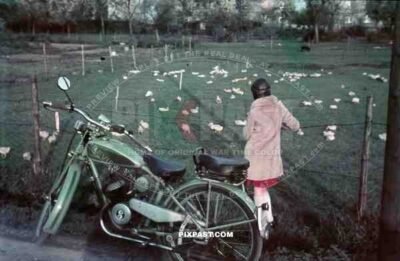
Woman in Red Skirt and Leather Helmet with Motorcycle Watching Ducks in Bremerhaven, Germany, 1939
Add to cart -
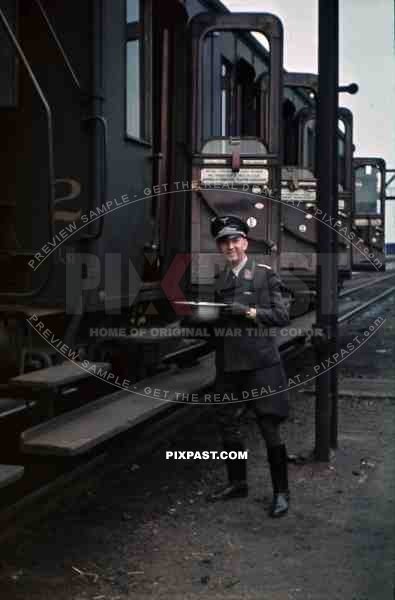
Luftwaffe Officer at Railway Carriage in Stendal, Germany, 1940
Add to cart -
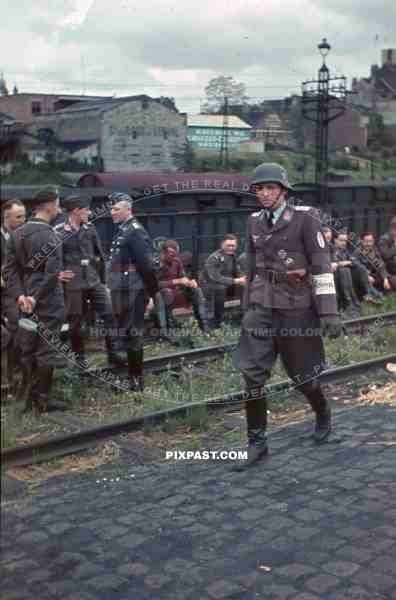
Luftwaffe Field Division Soldiers at Train Station, Etterbeek, Brussels, Belgium, 1941
Add to cart -
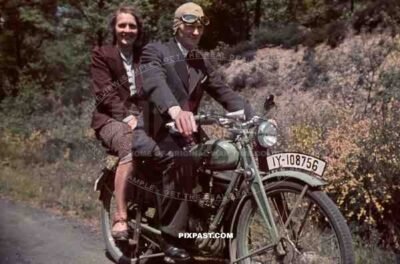
Bremerhaven 1939 NSU Motorcycle with Riding License IY-108756, Helmet and Goggles
Add to cart