
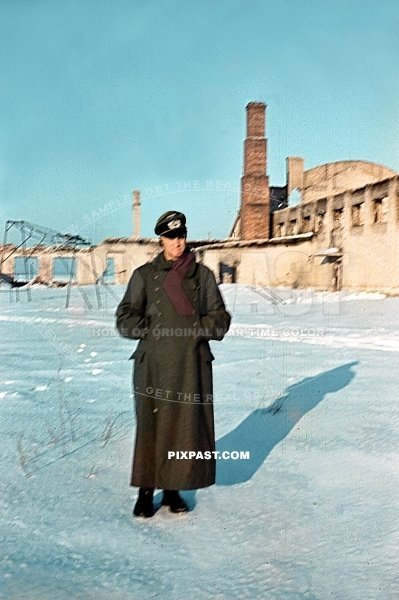
German Wehrmacht Infantry Officer of the Funker Radio Unit, 297 Infantry Division, Stalingrad Winter 1942
Digital Download Only: Upon purchase and successful payment, you will receive the selected image as a high-resolution JPG digital download. No physical photographs or printed copies are included in this transaction.
File details: JPG • 3,325 × 5,000 pixels
German Wehrmacht Infantry Officer of the Funker Radio Unit, 297 Infantry Division, Stalingrad Winter 1942
Description
This original color photograph shows a German Wehrmacht infantry officer standing outdoors in winter 1942 during the Battle of Stalingrad, Russia. He belongs to the Funker radio unit within the 297th Infantry Division. The officer wears a long, heavy coat suitable for cold weather, a dark scarf around his neck, and a peaked cap with insignia typical of Wehrmacht officers. In the background, ruined industrial buildings and snow-covered ground reflect the urban devastation of Stalingrad during the harsh winter of 1942. The image was captured on Agfacolor, a color film commonly used by German military photographers during World War II. This photograph provides valuable historical visual evidence of German military personnel and conditions during the critical Eastern Front campaign.
Dieses Originalfarbfoto zeigt einen Offizier der deutschen Wehrmacht im Winter 1942 während der Schlacht von Stalingrad, Russland. Der Offizier gehört zur Funker-Radioeinheit der 297. Infanterie-Division. Er trägt einen langen, schweren Mantel, der für kaltes Wetter geeignet ist, einen dunklen Schal und eine Schirmmütze mit den typischen Abzeichen der Wehrmachtoffiziere. Im Hintergrund sind zerstörte Industriegebäude und verschneiter Boden zu sehen, was mit der urbanen Verwüstung im winterlichen Stalingrad von 1942 übereinstimmt. Das Bild ist in Agfacolor aufgenommen, einem Farbfoto-Film, der häufig von deutschen Militärfotografen im Zweiten Weltkrieg verwendet wurde. Dieses Foto bietet wertvolle historische Sichtbeweise der deutschen Militärangehörigen und der Bedingungen an der Ostfront.
Related products
-
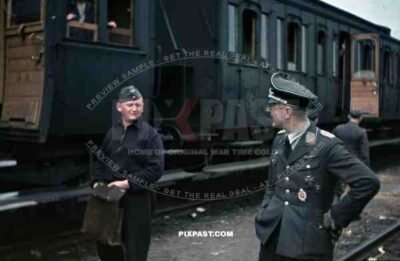
Luftwaffe Pilot with Awards at Railway Yard, Stendal, Germany, 1940
Add to cart -
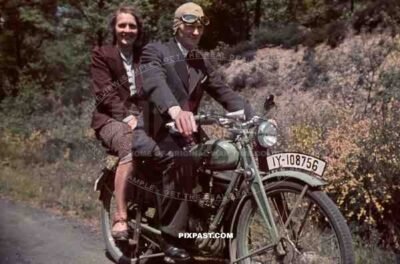
Bremerhaven 1939 NSU Motorcycle with Riding License IY-108756, Helmet and Goggles
Add to cart -
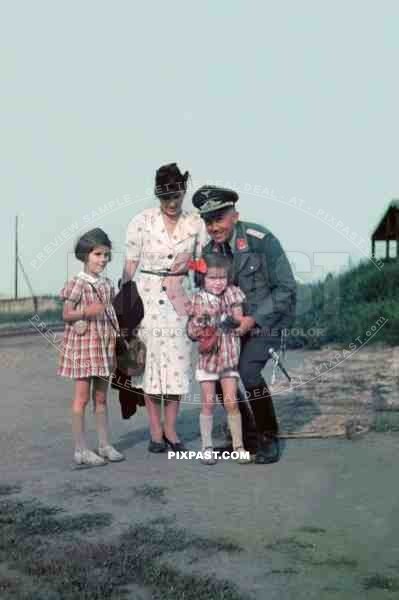
Germany Thuringen 1940 German Luftwaffe FLAK Officer in Uniform with Family
Add to cart -
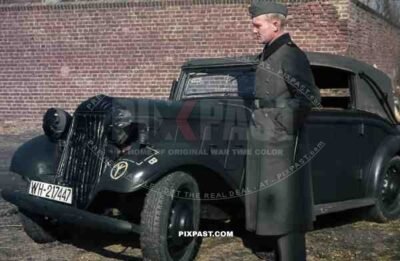
Wehrmacht Soldier Standing Beside 1938 Adler 2 Liter Cabriolet in Niederaußem, Germany 1940
Add to cart