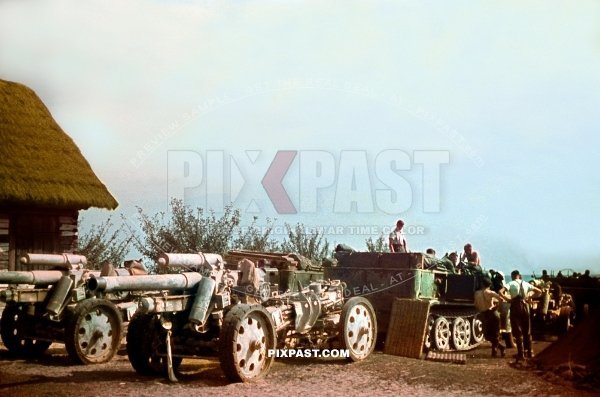
German Sd.Kfz. 7 8t Half-Track with 15 cm sFH 18 Howitzer Artillery Cannon, Poland 1939
Digital Download Only: Upon purchase and successful payment, you will receive the selected image as a high-resolution JPG digital download. No physical photographs or printed copies are included in this transaction.
File details: JPG • 5,000 × 3,311 pixels
German Sd.Kfz. 7 8t Half-Track with 15 cm sFH 18 Howitzer Artillery Cannon, Poland 1939
Description
This color photograph shows a German Sd.Kfz. 7 8-ton half-track towing a 15 cm sFH 18 (schwere Feldhaubitze 18) heavy howitzer artillery cannon. Both the half-track and artillery piece are set in a rural area, likely a village in Poland during the 1939 campaign. Soldiers are visible around and on the vehicles, with some seated atop the half-track, suggesting a moment of rest or preparation.
The 15 cm sFH 18 was a standard heavy howitzer used by German forces in World War II. The half-track is identifiable by its large road wheels and continuous track section at the rear, designed for towing artillery and transport. The rural architecture to the left, featuring thatched roofing, matches typical Eastern European village structures of that time.
Though the photograph’s original filename, IMGggg630.JPG, gives no specific location or date, archive research confirms this vehicle and gun combination was used by Artillerie Regiment 50, Germany, during the 1939 Polish campaign. The image was likely taken using Agfacolor film, which explains its vivid colors.
Diese Farbfotografie zeigt ein deutsches Sd.Kfz. 7 8-Tonnen Halbkettenfahrzeug, das eine 15 cm sFH 18 (schwere Feldhaubitze 18) schwere Haubitzenartillerie zieht. Das Halbkettenfahrzeug und die Geschütze befinden sich in einer ländlichen Umgebung, wahrscheinlich ein Dorf in Polen während des Feldzugs 1939. Soldaten sind um und auf den Fahrzeugen zu sehen, einige sitzen auf dem Halbkettenfahrzeug, was auf eine Ruhepause oder Vorbereitung hindeutet. Die 15 cm sFH 18 war eine Standardhaubitze der deutschen Streitkräfte im Zweiten Weltkrieg. Das Halbkettenfahrzeug ist an seinen großen Laufrädern und dem Kettenabschnitt hinten zur Geschützschleppung und zum Transport erkennbar. Das Originaldateiname IMGggg630.JPG gibt keine spezifischen Hinweise auf Ort oder Zeit außer der vorhandenen Archivforschung, die Polen 1939 angibt. Die links sichtbare ländliche Architektur mit Strohdach entspricht typischen osteuropäischen Dorfstrukturen dieser Zeit. Der Archivkontext bestätigt, dass diese Fahrzeug- und Geschütz-Kombination vom Artillerie-Regiment 50 im Polenfeldzug 1939 verwendet wurde. Das Foto wurde offenbar mit Agfacolor aufgenommen, einem damals verbreiteten Farbfilm, was die Farbigkeit erklärt.