
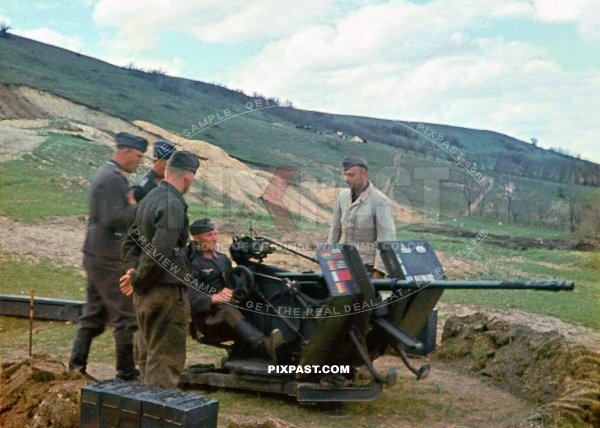
German 2 cm FlaK 38 Anti-Aircraft Gun Crew at Firing Range with Target Flags, 1940
Digital Download Only: Upon purchase and successful payment, you will receive the selected image as a high-resolution JPG digital download. No physical photographs or printed copies are included in this transaction.
File details: JPG • 5,000 × 3,567 pixels
German 2 cm FlaK 38 Anti-Aircraft Gun Crew at Firing Range with Target Flags, 1940
Description
This color photograph shows a group of German soldiers manning a 2 cm FlaK 38 anti-aircraft gun positioned in a dugout emplacement in open countryside. The gun has dual shields, each bearing painted or laminated panels with various national flags used as target markers. Visible flags include the French Tricolour and the Belgian flag, supporting the filename’s reference to French and Belgian target flags.
The scene likely depicts a 1940 wartime training or calibration exercise during the early years of the Second World War. The soldiers wear standard Luftwaffe field uniforms and caps. One soldier appears to be adjusting or preparing the gun for firing. The hilly, partially wooded background fits rural terrain.
The presence of these flags aligns with historical practice of marking targets with enemy national insignia for live-fire training. While the filename states the location as France or Belgium, the background alone does not definitively confirm this. No visible signage or landscape features conclusively identify the exact site.
The gun’s identification as a 2 cm FlaK 38 is medium confidence, based on the visible barrel length, mounts, and shield shape typical of this Luftwaffe weapon from the late 1930s to early 1940s. This Agfacolor slide from 1940 shows authentic German military equipment and personnel in a training context during the initial Western campaigns of WWII.
Dieses Farbfoto zeigt eine Gruppe deutscher Soldaten, die eine 2-cm-FlaK-38-Flugabwehrkanone in einer ausgehobenen Stellung im freien Gelände bedienen. Die Kanone ist mit zwei Schilden ausgestattet, auf denen bemalte oder laminierte Tafeln mit verschiedenen Nationalflaggen als Zielmarkierungen zu sehen sind – erkennbar sind unter anderem die französische Trikolore und die belgische Flagge, was mit dem Dateinamen übereinstimmt. Die Szene stellt vermutlich eine Übungen im Jahr 1940 während der frühen Phase des Zweiten Weltkriegs dar. Die Soldaten tragen typische Felduniformen und Mützen der Luftwaffe und bereiten die Kanone für das Schießen vor. Die hügelige, teils bewaldete Umgebung entspricht ländlichem Terrain. Die Nationalflaggen entsprechen der historischen Praxis, Feindesflaggen als Ziel beim Schießtraining zu verwenden. Der behauptete Standort in Frankreich oder Belgien ist plausibel, aber durch das Bild und die Umgebung nicht eindeutig belegbar. Die Identifizierung der Kanone als 2-cm-FlaK-38 ist mit mittlerer Sicherheit möglich, basierend auf Lauflänge, Aufhängung und Schildform, typisch für diese Luftwaffenwaffe des späten 1930er bis frühen 1940er Jahre. Das Bild ist eine Agfacolor-Diaschiebe von 1940 und zeigt authentische militärische Ausrüstung und Personal im Ausbildungskontext während der ersten Westfeldzüge des Zweiten Weltkriegs.
Related products
-
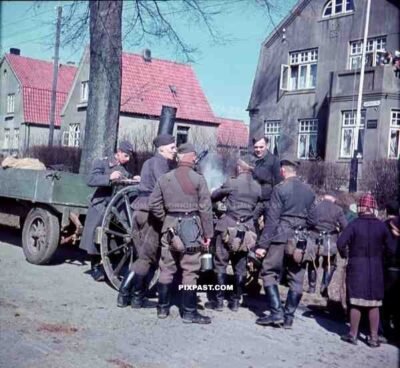
German Luftwaffe Flak Troops Eating Lunch at Mobile Field Kitchen in Norway Winter 1941
Add to cart -

Portrait of Young Man in 1930s Style Hat and Jacket, Germany, 1936
Add to cart -
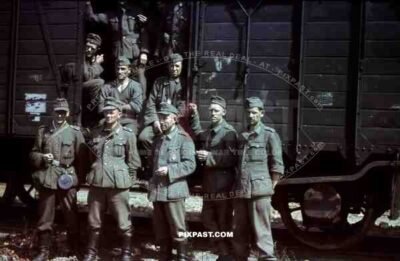
German Sicherungsbataillon 738 Soldiers in Front of a Train Wagon at Kokorewka, Russia 1944
Add to cart -
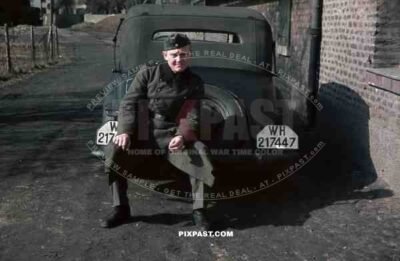
Wehrmacht Soldier by 1938 Adler 2 Liter Cabriolet in Niederaußem, Germany 1940
Add to cart