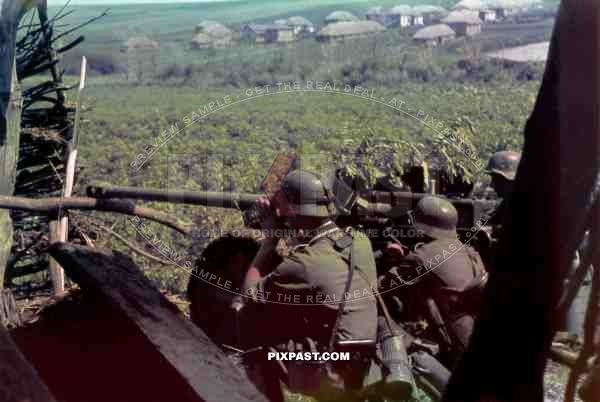
German Infantry with 50mm PAK Anti-Tank Gun near Russian Village, Southern Russia 1942
Digital Download Only: Upon purchase and successful payment, you will receive the selected image as a high-resolution JPG digital download. No physical photographs or printed copies are included in this transaction.
File details: JPG • 5,000 × 3,358 pixels
German Infantry with 50mm PAK Anti-Tank Gun near Russian Village, Southern Russia 1942
Description
This historical color photograph shows German infantrymen manning a 50mm Pak anti-tank gun positioned in a field, aiming toward a rural village in the distance. The soldiers wear typical Wehrmacht helmets and uniforms. The setting suggests an open agricultural landscape in Southern Russia.
In the background, several rural buildings or houses cluster in a small village, reflecting the Eastern European rural architecture of the period. The image, dated 1942, was likely taken near the Stalingrad area during the German military campaign in the Soviet Union.
The filename and archive context identify the weapon as a 50mm Pak (Panzerabwehrkanone) anti-tank cannon, a common German infantry support artillery piece. The colors and clarity indicate the photograph was taken on Agfacolor film, typical of German wartime usage.
Dieses historische Farbfoto zeigt deutsche Infanteristen, die eine 50-mm-Pak-Panzerabwehrkanone bedienen, die in einem Feld auf ein ländliches Dorf in der Ferne gerichtet ist. Die Soldaten tragen typische Wehrmachtshelme und Uniformen, und die Umgebung deutet auf die offene Agrarlandschaft Südrusslands hin. Im Hintergrund sind mehrere ländliche Gebäude oder Häuser zu sehen, die in einem kleinen Dorf gruppiert sind, was mit der osteuropäischen ländlichen Architektur der Zeit übereinstimmt. Das Bild ist auf das Jahr 1942 datiert und wurde wahrscheinlich in der Nähe des Gebiets um Stalingrad während der deutschen Militärkampagne in der Sowjetunion aufgenommen. Der Dateiname und der Archivkontext identifizieren die Waffe als eine 50-mm-Pak (Panzerabwehrkanone), eine gängige deutsche Infanterie-Unterstützungsartillerie. Die Farben und Klarheit deuten darauf hin, dass das Foto auf Agfacolor-Film, typisch für die deutsche Kriegszeit, aufgenommen wurde.