
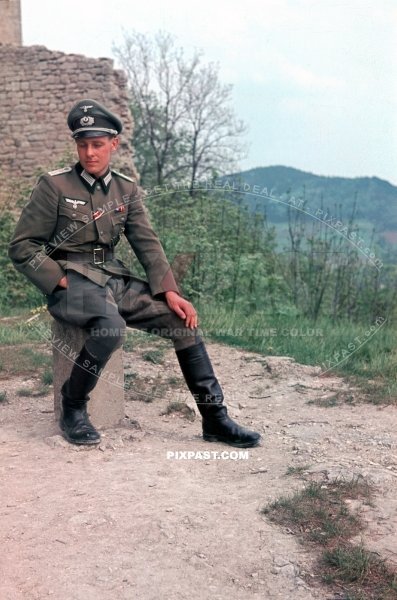
German Wehrmacht Infantry Officer Standing Beside Old Castle Ruins in Lindau, Germany, 1944
Digital Download Only: Upon purchase and successful payment, you will receive the selected image as a high-resolution JPG digital download. No physical photographs or printed copies are included in this transaction.
File details: JPG • 3,312 × 5,000 pixels
German Wehrmacht Infantry Officer Standing Beside Old Castle Ruins in Lindau, Germany, 1944
Description
This original historical color photograph, dated 1944 according to archive records, depicts a German Wehrmacht infantry officer in full uniform. He sits on a low stone wall beside the ruins of an old castle in Lindau, Germany. The officer wears the standard field tunic with infantry insignia and a peaked cap bearing the Wehrmacht eagle and cockade.
He sits on uneven ground with his right hand resting on his knee. Behind him, a partially ruined stone structure is visible. The background shows sparse trees and wooded hills, matching the topography around Lindau.
The photo is an Agfacolor slide, showcasing the vivid color detail typical of mid-1940s German wartime photography. The officer’s posture and uniform details are sharply visible. No military vehicles or equipment appear in the frame.
The original archive title and context remain unchanged, as no visual evidence contradicts them. However, despite the archive’s claims, the officer’s exact identity cannot be confirmed. The age of the stone ruins and the rural setting suggest a location near Lindau on Lake Constance (Bodensee), Germany.
Diese historische Farbfotografie zeigt einen deutschen Wehrmacht-Infanterieoffizier in vollständiger Uniform, der auf einer niedrigen Steinmauer neben den Ruinen einer alten Burg in Lindau, Deutschland, sitzt. Das Foto stammt laut Archivangaben aus dem Jahr 1944. Der Offizier trägt die Standarddienstjacke mit Infanterieabzeichen und eine Schirmmütze mit dem Wehrmachtsadler und dem Kokardenemblem. Er sitzt auf unebenem Boden, die rechte Hand ruht auf seinem Knie. Im Hintergrund sind teilweise beschädigte Steinmauern und bewaldete Hügel sichtbar, passend zur Topografie um Lindau. Das Bild wurde auf einem Agfacolor-Dia festgehalten und zeigt lebendige Farben, typisch für deutsche Kriegsfotografie der Mitte der 1940er Jahre. Einzeln erkennbare Fahrzeuge oder Geräte sind nicht zu sehen. Die ursprünglichen Archivangaben wurden unverändert übernommen, da keine widersprüchlichen Beweise vorliegen. Die Identität des Offiziers kann nicht bestätigt werden. Die alten Steine und die ländliche Umgebung weisen auf die Nähe von Lindau am Bodensee hin.
Related products
-
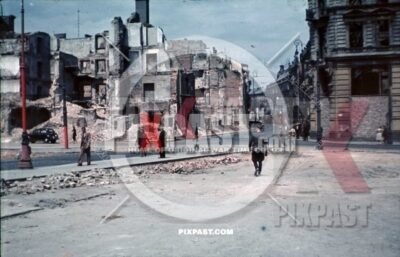
WW2 Color Photograph of Luftwaffe Officer Bindewald in Bombed Krakow, Poland, 1940
Add to cart -
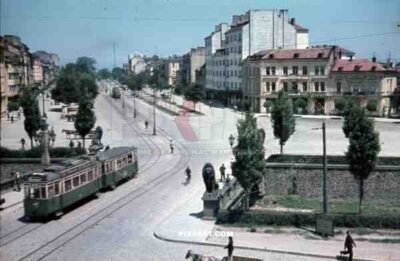
Lions Bridge with Tram in Sofia, Bulgaria, 1942
Add to cart -
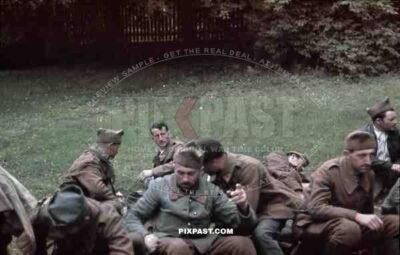
French Army POW Soldiers Near Verdun, France, 1940
Add to cart -
Luftwaffe Personnel Washing Dishes beside German Steam Locomotive Class 52, circa 1940
Add to cart