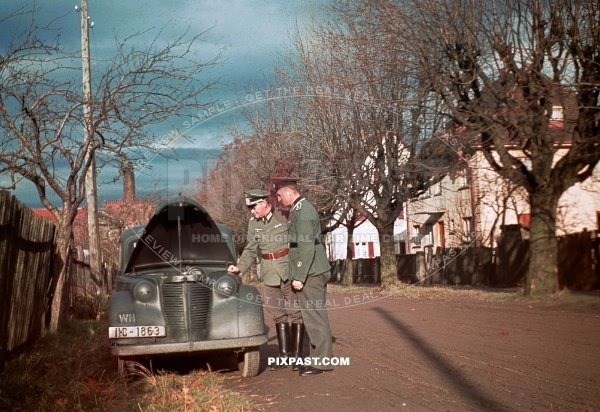
German Army Officers Inspecting an Opel Olympia Staff Car, circa 1939-1940
Digital Download Only: Upon purchase and successful payment, you will receive the selected image as a high-resolution JPG digital download. No physical photographs or printed copies are included in this transaction.
File details: JPG • 5,000 × 3,433 pixels
German Army Officers Inspecting an Opel Olympia Staff Car, circa 1939-1940
Description
This color photograph shows two German army artillery officers inspecting the engine of a small staff car identified as an Opel Olympia. The scene takes place on a rural street lined with leafless trees and modest buildings typical of late 1930s Germany. The vehicle’s front design, including the grille and headlights, matches the Opel Olympia model produced primarily in the late 1930s.
The license plate marked 'WH' signifies Wehrmacht Heer (German Army) use. According to archival context, the photograph likely dates to around 1939-1940 and was taken in or near Frankfurt, Germany. The officers wear uniforms typical of the German army during this period. This image offers a valuable historical record of German military logistics and staff transport in early World War II, captured using Agfacolor technology.
Diese Farbfotografie zeigt zwei deutsche Heer-Artillerieoffiziere, die den Motor eines kleinen Dienstwagens, identifiziert als Opel Olympia, inspizieren. Die Szene spielt auf einer ländlichen Straße, gesäumt von kahlen Bäumen und einfachen Gebäuden, typisch für Deutschland Ende der 1930er Jahre. Das Fahrzeug zeigt ein Frontdesign mit Kühlergrill und Scheinwerfern, das mit dem in den späten 1930er Jahren produzierten Opel Olympia übereinstimmt. Das Kennzeichen mit der Aufschrift 'WH' weist auf die Wehrmacht Heer (deutsches Heer) hin. Das Foto stammt wahrscheinlich aus den Jahren 1939-1940 und wurde in oder bei Frankfurt, Deutschland, aufgenommen, gemäß Archivangaben. Die Offiziere tragen Uniformen, die für das deutsche Heer dieser Zeit typisch sind. Das Bild ist ein wertvoller historischer Beleg der deutschen Militärlogistik und Dienstfahrzeuge während der frühen Phase des Zweiten Weltkriegs und wurde mit Agfacolor-Technologie aufgenommen.