
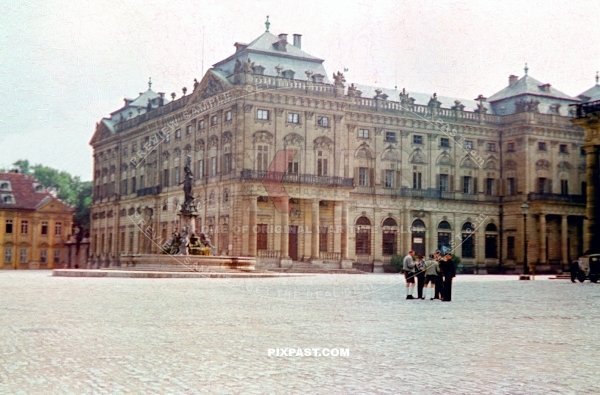
Frankoniabrunnen Fountain and Würzburg Residence, Würzburg, Germany, 1941
Digital Download Only: Upon purchase and successful payment, you will receive the selected image as a high-resolution JPG digital download. No physical photographs or printed copies are included in this transaction.
File details: JPG • 5,000 × 3,289 pixels
Frankoniabrunnen Fountain and Würzburg Residence, Würzburg, Germany, 1941
Description
This color photograph, likely taken in 1941 using Agfacolor film, shows the Frankoniabrunnen, a monumental fountain on Residenzplatz in front of the Würzburg Residence in Würzburg, Germany. The grand Baroque palace stands behind the fountain, displaying ornate architecture with statues, balconies, and multiple windows. The cobbled square in front is nearly empty, except for a small group of four people gathered near the fountain’s base. The photograph accurately reflects the size and layout of the site, confirming the filename and archive context that identify it as Würzburg in 1941. No vehicles are clearly visible or identifiable. This image provides historical insight into an important architectural and cultural landmark during wartime Germany. Although the original filename gave no specific location or date, the visible evidence and architectural details align with the applied context.
Dieses Farbfoto, vermutlich 1941 aufgenommen und mit Agfacolor-Film erstellt, zeigt den Frankoniabrunnen, einen monumentalen Brunnen auf dem Residenzplatz vor der Würzburger Residenz in Würzburg, Deutschland. Das grandiose Barockschloss ist hinter dem Brunnen sichtbar und zeigt eine verzierte Architektur mit Statuen, Balkonen und mehreren Fenstern. Der gepflasterte Platz vor dem Brunnen ist fast leer, bis auf eine kleine Gruppe von vier Personen, die sich nahe der Brunnenbasis versammelt haben. Das Foto entspricht genau der Größe und Anordnung des Ortes, was die Angaben des Dateinamens und des Archivkontexts bestätigt, die Würzburg im Jahr 1941 angeben. Keine Fahrzeuge sind deutlich sichtbar oder identifizierbar. Das Bild bietet einen historischen Einblick in dieses bedeutende architektonische und kulturelle Wahrzeichen im Deutschland während des Krieges.
Related products
-
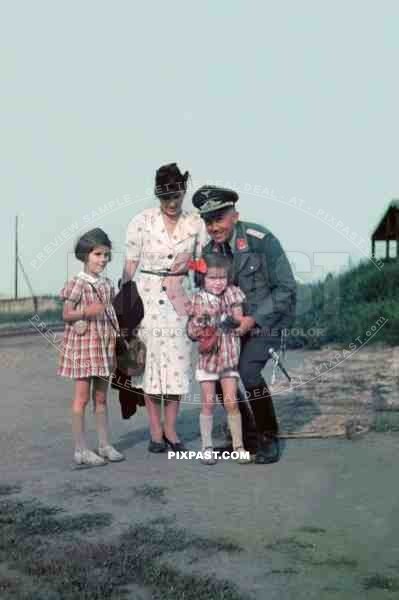
Germany Thuringen 1940 German Luftwaffe FLAK Officer in Uniform with Family
Add to cart -
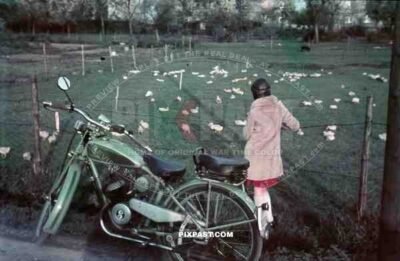
Woman in Red Skirt and Leather Helmet with Motorcycle Watching Ducks in Bremerhaven, Germany, 1939
Add to cart -
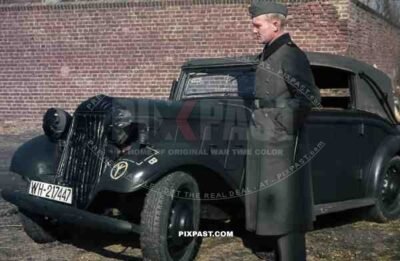
Wehrmacht Soldier Standing Beside 1938 Adler 2 Liter Cabriolet in Niederaußem, Germany 1940
Add to cart -
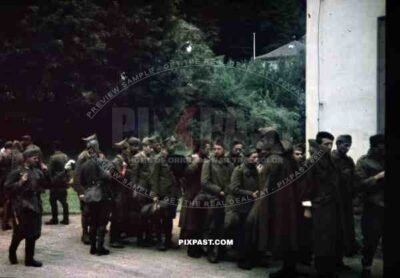
French Army POW Soldiers Near Verdun, France, 1940
Add to cart