

Knocked-out 3.7cm Flak Anti-Aircraft Gun in Vienna Street, April 1945
Digital Download Only: Upon purchase and successful payment, you will receive the selected image as a high-resolution JPG digital download. No physical photographs or printed copies are included in this transaction.
File details: JPG • 5,000 × 3,324 pixels
Knocked-out 3.7cm Flak Anti-Aircraft Gun in Vienna Street, April 1945
Description
This color photograph shows a knocked-out 3.7cm anti-aircraft gun on a cobbled street in Vienna, Austria, in April 1945. It was taken during the final urban combat of World War II in the city. The weapon appears damaged and abandoned amid war-torn surroundings typical of street fighting. The architecture, cobblestone paving, and German-language signage confirm a Central European urban setting consistent with Vienna. The gun is identified as a Russian-built Flak cannon, matching accounts of Soviet artillery used during the battle for Vienna. Visible features include the gun’s carriage and barrel, surrounded by debris. This photo is a valuable historical record of the intense street battles in Vienna during the closing months of the war. It comes from an original Agfacolor slide, reflecting the German wartime film technology used for color photography.
Dieses Farbfoto zeigt eine ausgeschaltete 3,7-cm-Flugabwehrkanone in einer gepflasterten Straße von Wien, Österreich, im April 1945 während der letzten Stadtkämpfe des Zweiten Weltkriegs in der Stadt. Die Waffe wirkt beschädigt und verlassen in einem kriegszerstörten Umfeld, typisch für die Straßenkämpfe jener Zeit. Die Architektur, das Kopfsteinpflaster und die deutschsprachigen Schilder bestätigen eine mitteleuropäische Stadtkulisse, die mit Wien übereinstimmt. Die Kanone wird als russische Flak-Kanone identifiziert, was mit Berichten über sowjetische Artillerie im Kampf um Wien übereinstimmt. Sichtbare Merkmale sind der Lafettenwagen und das Rohr der Kanone mit umliegenden Trümmern. Das Foto ist ein wertvolles historisches Dokument der intensiven Straßenkämpfe in Wien in den letzten Monaten des Zweiten Weltkriegs. Das Bild stammt von einer Original Agfacolor-Diaserie, welche die deutsche Kriegsfilmtechnik für Farbaufnahmen zeigt.
Related products
-
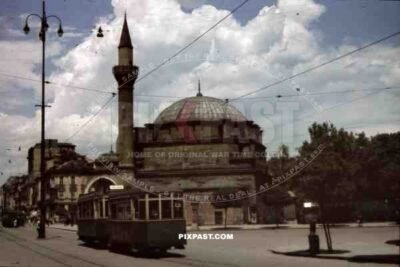
Banja-Baschi Mosque and Sofia Tram, Bulgaria 1942
Add to cart -
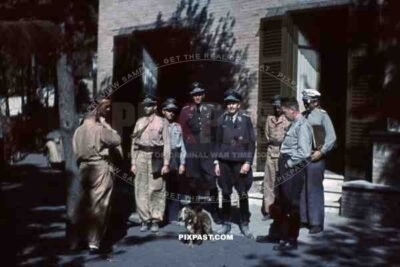
German Luftwaffe Officers Meeting for Strategy in Sicily, 1943
Add to cart -
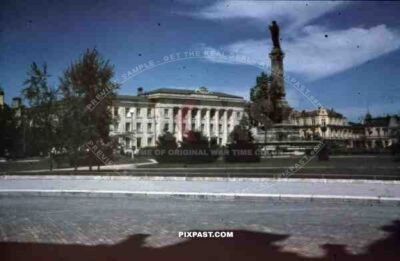
Liberty Monument and Courthouse in Ruse, Bulgaria, 1943
Add to cart -
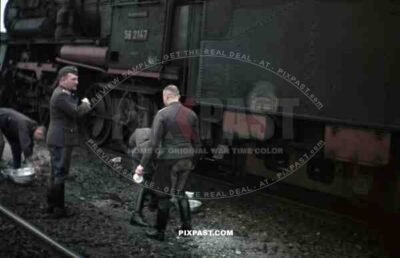
Luftwaffe Personnel Washing Dishes beside German Steam Locomotive Class 52, circa 1940
Add to cart