

Dodge WC-57 Command Car in Ruined St. Lô, Normandy 1944
Digital Download Only: Upon purchase and successful payment, you will receive the selected image as a high-resolution JPG digital download. No physical photographs or printed copies are included in this transaction.
File details: JPG • 3,320 × 5,000 pixels
Dodge WC-57 Command Car in Ruined St. Lô, Normandy 1944
Description
This original color photograph shows a Dodge WC-57 command car parked on a road in front of extensive war-damaged ruins in St. Lô, Normandy, France. The buildings are severely damaged, with some walls and structures partially toppled, reflecting destruction from the Battle of Normandy in 1944. Visible signs include "Hotel de l'Est" and "Michel," indicating local establishments heavily damaged or destroyed during the fighting. The Dodge WC-57 command car was widely used by American forces in World War II. The image is dated June 1944 and is linked to the 166th Signal Photographic Company, a U.S. Army unit responsible for combat photography and documentation. This photograph captures both the extensive urban destruction and the presence of American military vehicles during the liberation of Normandy.
Cette photographie couleur originale montre une voiture de commandement Dodge WC-57 garée sur une route devant les ruines très endommagées de bâtiments à St. Lô, en Normandie, France. Les bâtiments sont gravement endommagés, avec certains murs et structures partiellement effondrés, ce qui est conforme à la destruction causée lors de la bataille de Normandie en 1944. Des enseignes visibles comprennent « Hôtel de l'Est » et « Michel », indiquant des établissements locaux détruits ou très endommagés pendant les combats. Le véhicule, une voiture de commandement Dodge WC-57, était largement utilisé par les forces américaines pendant la Seconde Guerre mondiale. Le contexte historique le situe en juin 1944 et l'associe à la 166e compagnie signal photographique, une unité de l'armée américaine responsable de la photographie de combat et de la documentation. Cette photographie capture à la fois l'importante destruction urbaine due à la bataille et la présence de véhicules militaires américains lors de la libération de la Normandie.
Related products
-
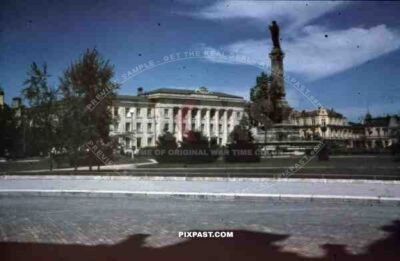
Liberty Monument and Courthouse in Ruse, Bulgaria, 1943
Add to cart -
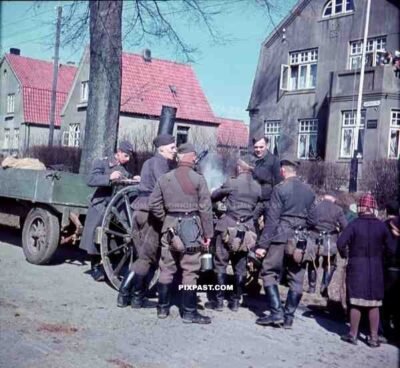
German Luftwaffe Flak Troops Eating Lunch at Mobile Field Kitchen in Norway Winter 1941
Add to cart -

Luftwaffe Soldiers by Train Wagon at Stendal Railway Yard, Germany 1940
Add to cart -
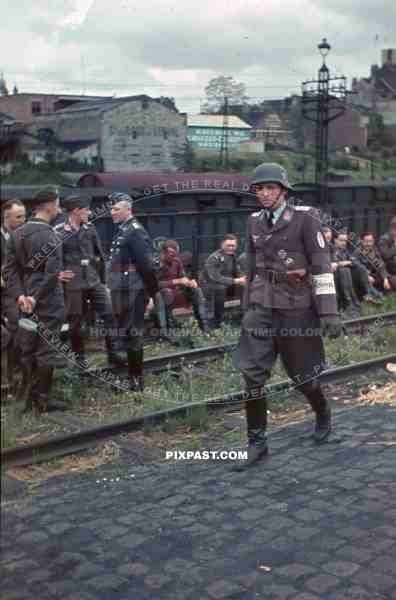
Luftwaffe Field Division Soldiers at Train Station, Etterbeek, Brussels, Belgium, 1941
Add to cart