Destroyed German Panzerkampfwagen III Ausf. F Tank near Stary Bychow, 1941
Digital Download Only: Upon purchase and successful payment, you will receive the selected image as a high-resolution JPG digital download. No physical photographs or printed copies are included in this transaction.
File details: JPG • 5,000 × 3,272 pixels
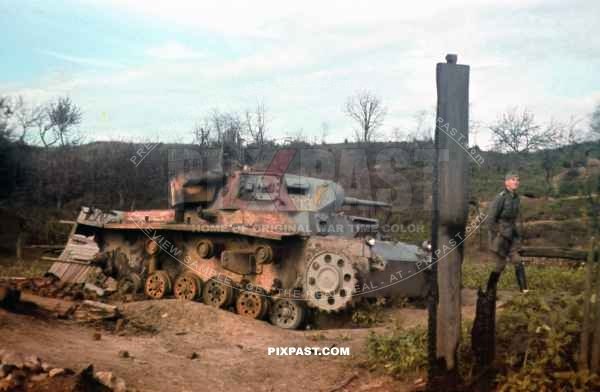
Destroyed German Panzerkampfwagen III Ausf. F Tank near Stary Bychow, 1941
Description
This original historical color photograph shows a destroyed German Panzerkampfwagen III (Pz.Kpfw. III) Ausf. F tank abandoned in a rural area near Stary Bychow on the Dniepr River. The tank, identified by its shape and turret features, has significant battle damage, with its track and chassis components visibly destroyed. A soldier stands nearby beside a wooden post and wire fence, providing scale and context.
The image dates to early July 1941, during the German invasion of the Soviet Union in World War II. Archive documentation links the tank to the 3rd Company, I Battalion, Panzer Regiment 35, confirmed by the distinctive tactical marking on the turret resembling a yellow bear. The tank’s tactical number, 333, is also recorded. Likely sourced from a German wartime Agfacolor slide, the scene depicts a rural Eastern European environment with leafless trees and modest fencing. This photograph offers a valuable color example of armored warfare losses on the Eastern Front, illustrating the condition and setting of a mid-war German armored vehicle.
Dieses originale historische Farbfoto zeigt einen zerstörten deutschen Panzerkampfwagen III (Pz.Kpfw.III) Ausf. F, erkennbar an seiner Form und den Turmmerkmalen, der in einer ländlichen Landschaft nahe Stary Bychow am Fluss Dnjepr zurückgelassen wurde. Der Panzer weist erhebliche Kampfschäden auf, mit sichtbar zerstörten Ketten- und Fahrgestellteilen. Ein Soldat steht in der Nähe neben einem Holzmast und einem Drahtzaun, was Maßstab und Kontext gibt. Die Szene spielt Anfang Juli 1941 während des deutschen Überfalls auf die Sowjetunion im Zweiten Weltkrieg, speziell in Verbindung mit der 3. Kompanie, I. Bataillon, Panzerregiment 35, wie es durch Archivdokumente und die charakteristische taktische Markierung in Form eines gelben Bären am Turm angezeigt wird. Die taktische Nummer 333 des Panzers ist dokumentiert, und das Bild stammt wahrscheinlich von einer deutschen Kriegs-Agfacolor-Diasaufnahme. Die Umgebung ist eine ländliche osteuropäische Landschaft mit kahlen Bäumen und bescheidener Einzäunung, passend zur Zeit und zum Ort. Das Foto ist ein wertvolles Farbbeispiel für Verluste gepanzerter Verbände an der Ostfront und verdeutlicht Zustand und Umfeld eines deutschen mittleren Kampfpanzers im Kriegsmittel.