
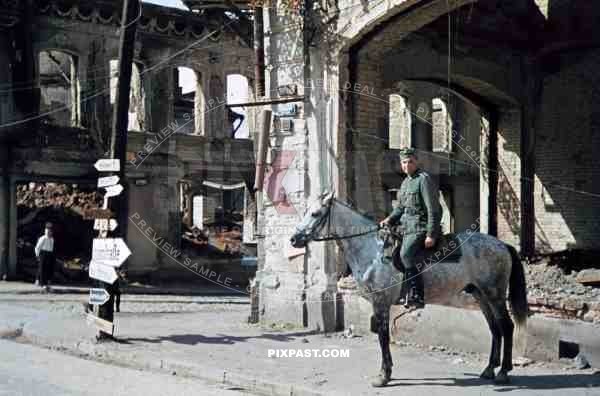
German Soldier on Horseback Amongst Destroyed Buildings, Minsk, Belarus, 1941
Digital Download Only: Upon purchase and successful payment, you will receive the selected image as a high-resolution JPG digital download. No physical photographs or printed copies are included in this transaction.
File details: JPG • 5,000 × 3,302 pixels
German Soldier on Horseback Amongst Destroyed Buildings, Minsk, Belarus, 1941
Description
This historical color photograph shows a German soldier mounted on a gray horse standing among the ruins of heavily damaged buildings in Minsk, Belarus, in June 1941. The soldier appears to be guiding or directing a convoy. Archival notes identify the location as Zakharievskaya Street, called "Hauptstraße" by German forces. The surrounding destruction reflects intense fighting during the early Eastern Front operations of World War II, specifically the Wehrmacht’s advance toward Smolensk.
The image captures urban war damage, military presence, and the use of a horse for transport or communication under wartime conditions. No motor vehicles appear in the frame. The photograph illustrates the impact of combat on civilian infrastructure during this period. The identities of the soldier and horse cannot be verified from the image. Minsk was then part of the Soviet Union, not Russia, as older records sometimes ambiguously state. This color slide was taken by Franz Krieger, a known photographer of German World War II subjects.
Это историческое цветное фото показывает немецкого солдата на сером коне среди разрушенных зданий в Минске, Беларусь, в июне 1941 года. На снимке солдат, видимо, указывает путь конвою на улице Захарьевская, известной у немцев как «Хауптштрассе». Видны разрушения, вызванные боевыми действиями, что соответствует раннему этапу Великой Отечественной войны и продвижению Вермахта к Смоленску. Фотография отражает военное присутствие и последствия боевых действий для городской инфраструктуры того времени. Точная личность солдата и коня неопределенна. Место — Минск, Беларусь, а не Россия. Фото сделано Францем Кригером, фотографом Второй мировой войны.
Related products
-
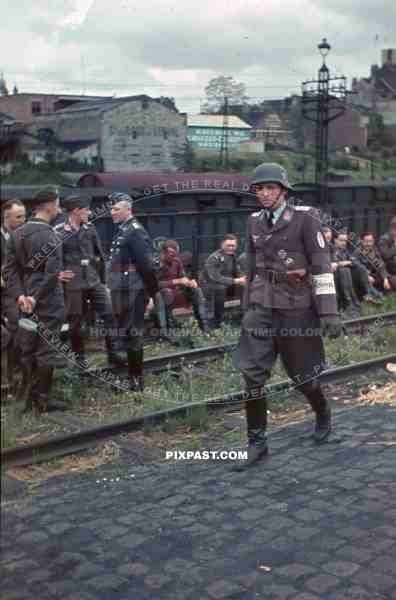
Luftwaffe Field Division Soldiers at Train Station, Etterbeek, Brussels, Belgium, 1941
Add to cart -
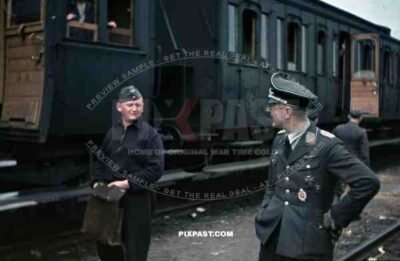
Luftwaffe Pilot with Awards at Railway Yard, Stendal, Germany, 1940
Add to cart -
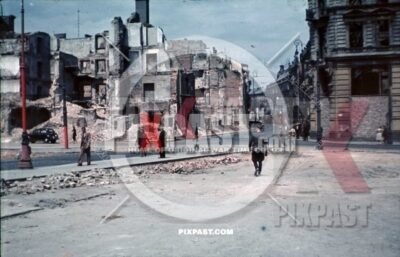
WW2 Color Photograph of Luftwaffe Officer Bindewald in Bombed Krakow, Poland, 1940
Add to cart -
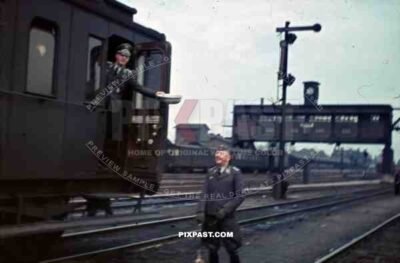
Luftwaffe Officers Cleaning Train Toilet at Stendal Railway Yard, Germany 1940
Add to cart