

Converted Hotel as German Army Hospital Soldatenheim with Cinzano Advert, Occupied Paris 1940
Digital Download Only: Upon purchase and successful payment, you will receive the selected image as a high-resolution JPG digital download. No physical photographs or printed copies are included in this transaction.
File details: JPG • 5,000 × 3,283 pixels
Converted Hotel as German Army Hospital Soldatenheim with Cinzano Advert, Occupied Paris 1940
Description
This original color photograph from 1940 shows a street scene in occupied Paris featuring a converted hotel used as a German Army hospital or "Soldatenheim." The large building prominently displays a sign reading "Soldatenheim," flanked by two Red Cross symbols, indicating its medical or rest home function for soldiers. Above this sign is a large billboard advertising Cinzano, an Italian vermouth brand, reflecting commercial presence during the occupation.
To the left, a faded advertisement for "HOLO VON" is partially visible on the adjacent building. In front of the hotel and along the street runs a green city bus with a distinctive rounded roof, typical of early 20th-century European urban transport. Several people, including German soldiers identifiable by their uniform caps and military attire, stand in the foreground. Trees lining the street suggest a boulevard setting. The photograph captures a historical moment in wartime Paris, illustrating the intersection of military presence, civilian life, and commercial advertising.
Cette photographie couleur originale, datée de 1940, montre une scène de rue dans le Paris occupé avec un hôtel converti en hôpital militaire allemand ou « Soldatenheim ». Le grand bâtiment affiche clairement un panneau indiquant « Soldatenheim » flanqué de deux croix rouges, signalant sa fonction médicale ou de maison de repos pour soldats. Au-dessus, une grande publicité pour Cinzano, une marque italienne de vermouth, souligne la présence commerciale pendant l'occupation. Sur le bâtiment adjacent à gauche, une publicité partiellement visible pour « HOLO VON » est perceptible. Devant l'hôtel et le long de la rue, un autobus urbain vert, au toit arrondi caractéristique des transports européens du début du XXe siècle, circule. Plusieurs personnes, dont des soldats allemands reconnaissables à leurs casquettes et uniformes militaires, sont présentes au premier plan, confirmant l'identification archivistique du lieu et de la période. Des arbres bordent la rue, suggérant un boulevard. La photographie saisit un moment historique de Paris en temps de guerre sous occupation allemande, montrant l'intersection entre présence militaire, vie civile et publicité commerciale.
Related products
-
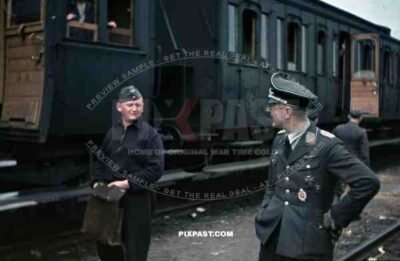
Luftwaffe Pilot with Awards at Railway Yard, Stendal, Germany, 1940
Add to cart -
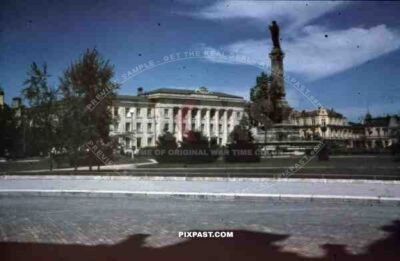
Liberty Monument and Courthouse in Ruse, Bulgaria, 1943
Add to cart -
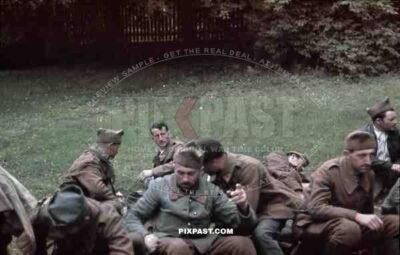
French Army POW Soldiers Near Verdun, France, 1940
Add to cart -
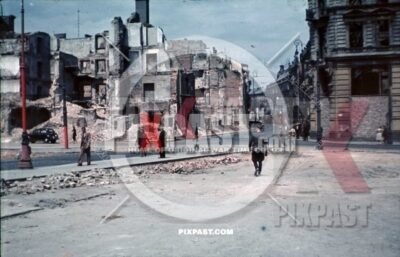
WW2 Color Photograph of Luftwaffe Officer Bindewald in Bombed Krakow, Poland, 1940
Add to cart