
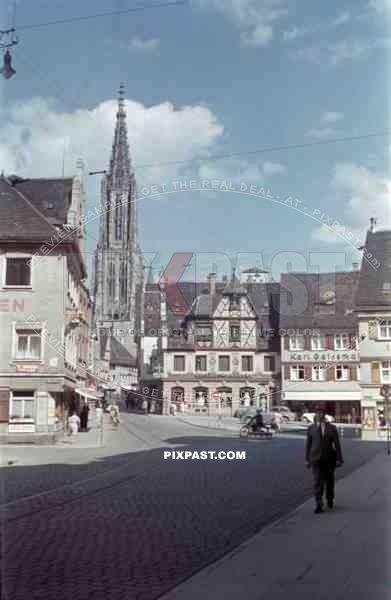
Ulm Minster and City Street, Germany c. 1940
Digital Download Only: Upon purchase and successful payment, you will receive the selected image as a high-resolution JPG digital download. No physical photographs or printed copies are included in this transaction.
File details: JPG • 3,266 × 5,000 pixels
Ulm Minster and City Street, Germany c. 1940
Description
This original color photograph shows a street view in Ulm, Germany, with the Ulm Minster church spire dominating the skyline. The Minster’s tall, ornate Gothic spire rises clearly behind traditional multi-story buildings with shopfronts lining the street. The architecture reflects a typical German town center.
Several pedestrians walk along the pavement and street. Early 20th-century vehicles are parked and moving along the cobbled road. The scene conveys a peaceful urban atmosphere, likely dating to around 1940. This estimate is based on the archival context and the photographic coloration typical of Agfacolor slides from that period.
The filename '2008829' does not provide explicit location or date information. However, historical notes in the collection verify the setting as Ulm, Germany, around 1939-1940. Vehicle details are insufficient for precise identification but match pre-World War II German automotive styles, further supporting the estimated date.
Dieses Original-Farbfoto zeigt eine Straßenansicht in Ulm, Deutschland, mit dem markanten Ulmer Münster, dessen hoher gotischer Turm die Skyline dominiert. Der Turm des Münsters ist deutlich hinter den traditionellen mehrstöckigen Gebäuden mit Ladenfronten an der Straße sichtbar. Die Architektur entspricht einem typischen deutschen Stadtzentrum. Mehrere Passanten sind auf dem Bürgersteig und der Straße zu sehen, ebenso wie Fahrzeuge aus der Frühen 20. Jahrhunderts, die auf der gepflasterten Straße parken oder fahren. Das Bild vermittelt eine ruhige Stadtszene, die auf etwa 1940 datiert werden kann, wie die Archivangaben und die Farbgebung der Agfacolor-Dias dieser Zeit nahelegen. Der Dateiname „2008829“ liefert keine expliziten Orts- oder Datumsangaben, jedoch bestätigen die historischen Hinweise der Sammlung, dass es sich um Ulm, Deutschland, um 1939–1940 handelt. Fahrzeugdetails sind nicht ausreichend für eine genaue Identifikation, entsprechen jedoch deutschen Automobilstilen vor dem Zweiten Weltkrieg und unterstützen somit die Datierung.
Related products
-
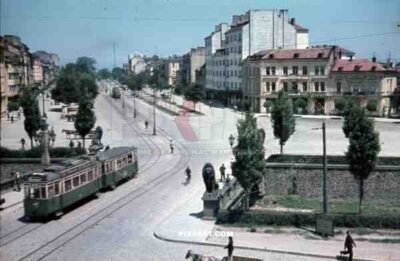
Lions Bridge with Tram in Sofia, Bulgaria, 1942
Add to cart -
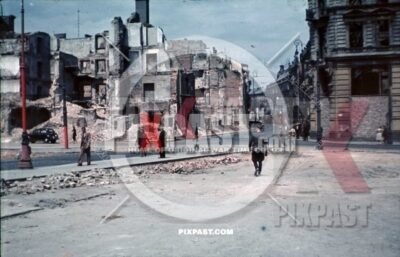
WW2 Color Photograph of Luftwaffe Officer Bindewald in Bombed Krakow, Poland, 1940
Add to cart -
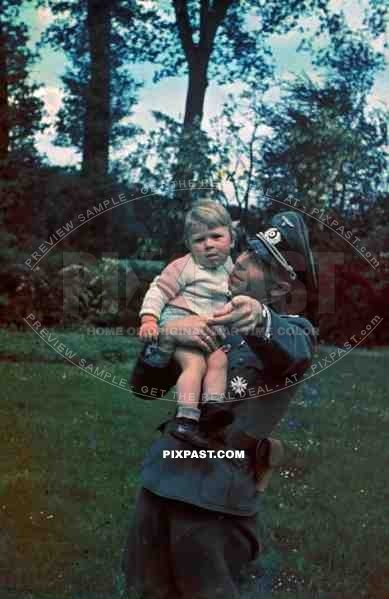
World War II German Cavalry Officer with Child, Frankfurt 1940
Add to cart -
Luftwaffe Officers Cleaning Train Toilet at Stendal Railway Yard, Germany 1940
Add to cart