
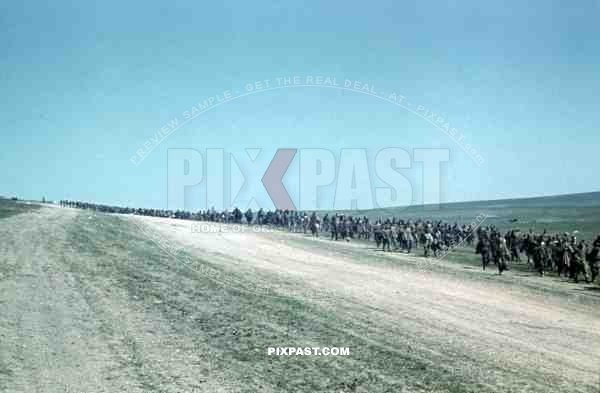
Captured Russian Prisoners of War Marching near Kretsch, Crimea, 1942
Digital Download Only: Upon purchase and successful payment, you will receive the selected image as a high-resolution JPG digital download. No physical photographs or printed copies are included in this transaction.
File details: JPG • 5,000 × 3,278 pixels
Captured Russian Prisoners of War Marching near Kretsch, Crimea, 1942
Description
This historical color photograph, dated 1942 according to archive records, shows a large group of captured Russian prisoners of war being marched along a dirt road in a rural area near Kretsch (Kretsch), Crimea, during World War II. The wide, open landscape with sparse grass and the long line of detainees stretching across the horizon are clearly visible. Archive context associates the image with the German 22nd Panzer Division, although no German military vehicles or soldiers are distinctly visible in the frame. The photograph was taken using Agfacolor film, as indicated by the color tones and style typical of German wartime color photography of the period. The filename and archival research confirm these details, with no contradictory evidence in the image. This rural Crimean scene and the portrayal of POWs offer valuable historical documentation of the Eastern Front conflict in 1942.
Dieses historische Farbfoto, laut Archivangaben aus dem Jahr 1942, zeigt eine große Gruppe gefangener russischer Kriegsgefangener, die während des Zweiten Weltkriegs auf einer unbefestigten Straße in einer ländlichen Gegend in der Nähe von Kretsch (Kretsch), Krim, marschieren. Die weite offene Landschaft mit spärlichem Gras und die lange Reihe der Gefangenen, die sich am Horizont entlangzieht, sind deutlich sichtbar. Das Bild steht im Zusammenhang mit der deutschen 22. Panzer-Division, basierend auf dem Archivkontext, obwohl keine deutschen Militärfahrzeuge oder Soldaten im sichtbaren Bildausschnitt eindeutig zu identifizieren sind. Das Foto wurde mit Agfacolor-Film aufgenommen, erkennbar an den Farbtönen und dem Stil der Diaaufnahme, die für deutsche Kriegsfarbfotografien dieser Zeit charakteristisch sind. Der Dateiname und die Archivforschung bestätigen diese Angaben, ohne dass widersprüchliche Beweise im Bild vorliegen. Der ländliche Krim-Kontext und die Darstellung von Kriegsgefangenen bieten wertvolle historische Dokumentation des Ostfront-Konflikts im Jahr 1942.
Related products
-
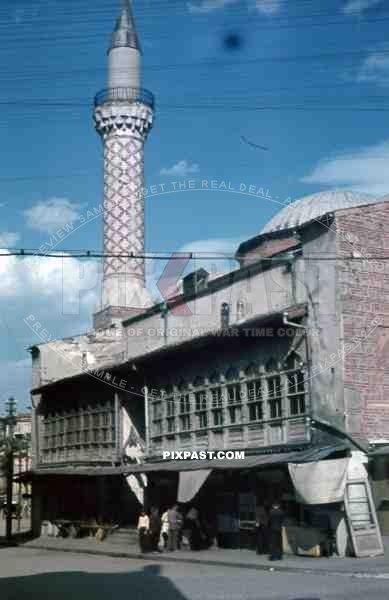
Dzhumaya Mosque and Market Buildings in Plovdiv, Bulgaria 1942
Add to cart -
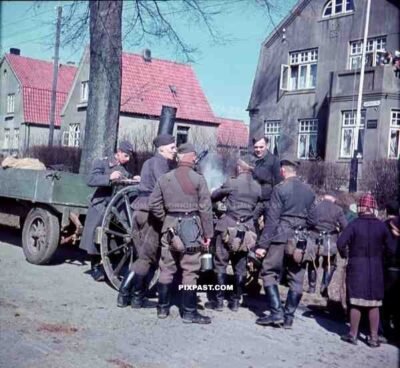
German Luftwaffe Flak Troops Eating Lunch at Mobile Field Kitchen in Norway Winter 1941
Add to cart -
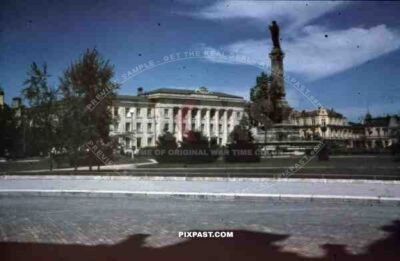
Liberty Monument and Courthouse in Ruse, Bulgaria, 1943
Add to cart -
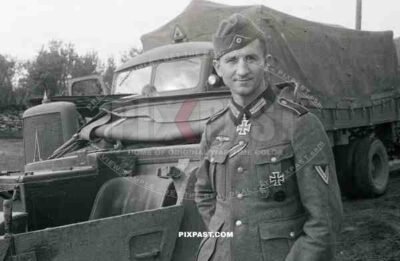
Obergefreiter Richard Gambietz with German Military Truck, Russia 1942
Add to cart