
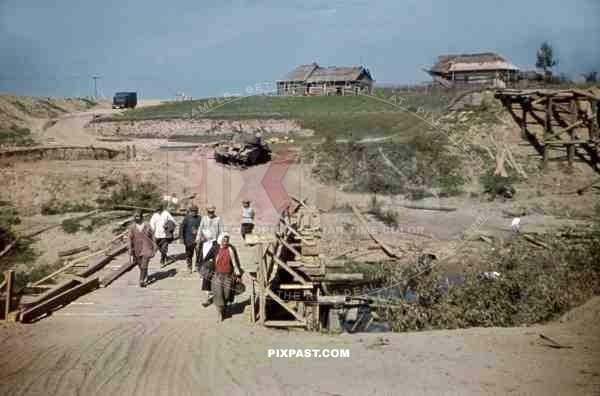
Captured Russian BT-7 Tank Near Smolensk, Summer 1941
Digital Download Only: Upon purchase and successful payment, you will receive the selected image as a high-resolution JPG digital download. No physical photographs or printed copies are included in this transaction.
File details: JPG • 5,000 × 3,303 pixels
Captured Russian BT-7 Tank Near Smolensk, Summer 1941
Description
This historical color photograph depicts a wartime rural scene near Smolensk, Russia, in the summer of 1941. The main focus is a captured Russian BT-7 tank positioned on a raised embankment behind a dirt bridge. Civilians and military personnel cross the bridge in the foreground. The tank matches archival records identifying it as a BT-7M model, equipped with a P-40 anti-aircraft mount, a V2 diesel engine, and a DT-29 machine gun.
The image shows dusty dirt roads and modest wooden buildings scattered across a grassy hillside. It captures the Eastern Front during World War II, linked to the 19th Panzer Division’s summer campaign near Smolensk. Visible details confirm the vehicle and location, supported by the filename and collection context. The slide’s color quality reflects the Agfacolor technology used by German photographers at the time.
Dieses historische Farbfoto zeigt eine ländliche Kriegsszene in der Nähe von Smolensk, Russland, im Sommer 1941. Das Hauptmotiv ist ein erbeuteter russischer BT-7-Panzer, der auf einem erhöhten Damm hinter einer von Zivilisten und Militärpersonal überquerten Erdbrücke steht. Der Panzer entspricht den vorhandenen Archivdaten, die ihn als BT-7M mit P-40-Flugabwehr-Montierung, V2-Dieselmotor und DT-29-Maschinengewehr identifizieren. Das Foto zeigt staubige Erdstraßen zwischen einfachen Holzgebäuden auf einem grasbewachsenen Hügel. Das Bild spiegelt den Kontext der Ostfront im Zweiten Weltkrieg wider, speziell die 19. Panzer-Division während der Sommeroffensive 1941 nahe Smolensk. Die sichtbaren Details stützen die Identifizierung des Fahrzeugs und des Ortes, bestätigt durch Dateiname und Archivkontext. Die Farbabstufung entspricht der Agfacolor-Technik, die zu dieser Zeit von deutschen Fotografen verwendet wurde.
Related products
-
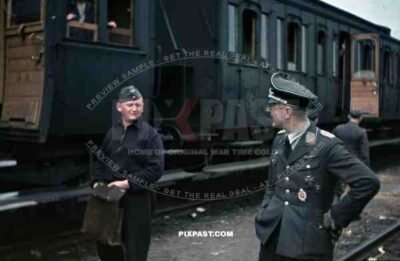
Luftwaffe Pilot with Awards at Railway Yard, Stendal, Germany, 1940
Add to cart -
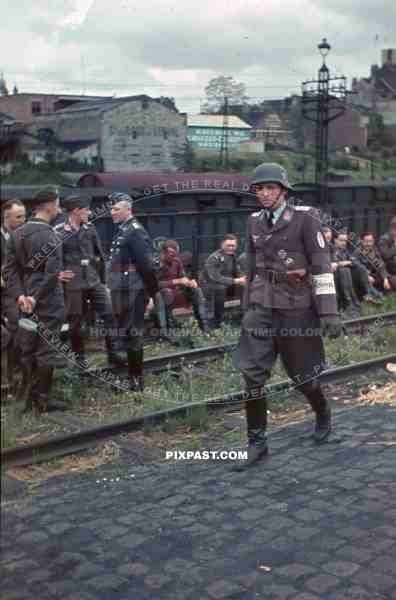
Luftwaffe Field Division Soldiers at Train Station, Etterbeek, Brussels, Belgium, 1941
Add to cart -
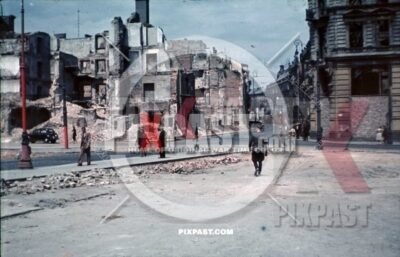
WW2 Color Photograph of Luftwaffe Officer Bindewald in Bombed Krakow, Poland, 1940
Add to cart -

Luftwaffe Soldiers by Train Wagon at Stendal Railway Yard, Germany 1940
Add to cart