
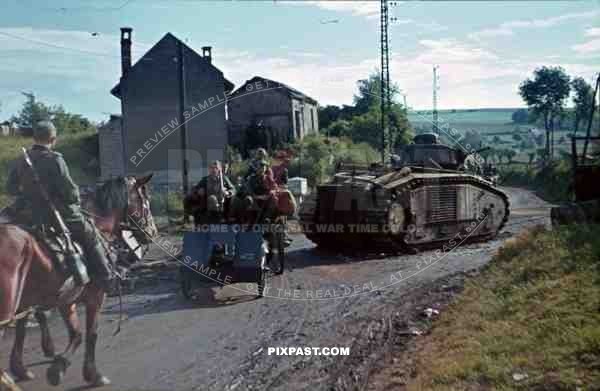
Captured French Char B1 Tank with German Cavalry, France 1940
Digital Download Only: Upon purchase and successful payment, you will receive the selected image as a high-resolution JPG digital download. No physical photographs or printed copies are included in this transaction.
File details: JPG • 5,000 × 3,266 pixels
Captured French Char B1 Tank with German Cavalry, France 1940
Description
This color photograph shows a captured French Char B1 tank abandoned on a rural road in France in 1940. The tank sits near buildings that show signs of battle or abandonment. On the left side, several German cavalrymen on horseback are visible, indicating German forces in the area.
The image is connected to the 14th Panzer Division, specifically the 103rd Schützen Regiment, during the German campaign in France in World War II. The photo was taken in natural daylight under a partly cloudy sky. The terrain and architecture reflect the typical French countryside.
The tank is identifiable as a Char B1 heavy tank by its distinctive shape and tracks. This was a key French armored vehicle in 1940. The presence of mounted troops alongside the captured tank highlights the dynamics of the early stages of World War II in Western Europe.
Diese Farbaufnahme zeigt einen erbeuteten französischen Char B1-Panzer, der 1940 auf einer Landstraße in Frankreich verlassen wurde. Der Panzer steht in der Nähe von Gebäuden, die Kampfspuren oder Aufgabe zeigen. Links im Bild sind mehrere deutsche Kavalleristen auf Pferden zu sehen, was auf die Präsenz deutscher Truppen in diesem Gebiet hinweist. Das Bild steht im Zusammenhang mit der 14. Panzer-Division, speziell dem 103. Schützen-Regiment, die Teil der deutschen Armee-Kampagne in Frankreich im Zweiten Weltkrieg waren. Das Foto wurde bei Tageslicht mit teilweise bewölktem Himmel aufgenommen, und das Gelände sowie die Architektur sind typisch für die französische Landschaft. Der Panzer ist durch seine charakteristische Form und Ketten als Char B1-Mittelgewichtspanzer identifizierbar, ein wichtiges französisches Fahrzeug von 1940. Die Anwesenheit von Reitern und der erbeutete Status des Panzers spiegeln die Dynamik der frühen Phase des Zweiten Weltkriegs in Westeuropa wider.
Related products
-
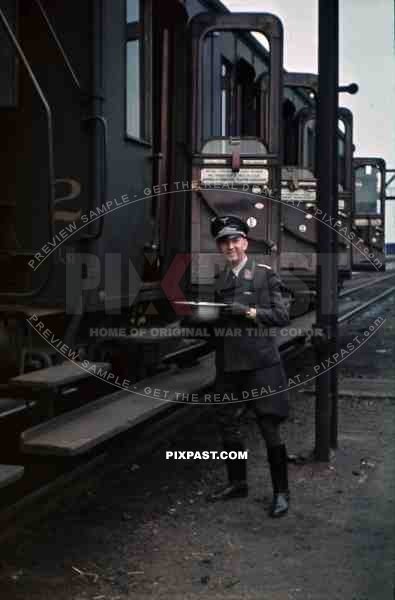
Luftwaffe Officer at Railway Carriage in Stendal, Germany, 1940
Add to cart -
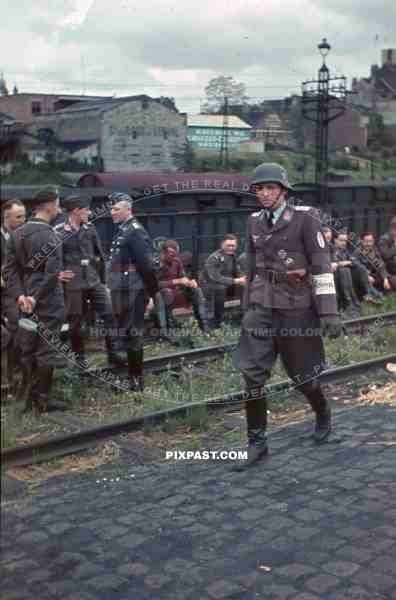
Luftwaffe Field Division Soldiers at Train Station, Etterbeek, Brussels, Belgium, 1941
Add to cart -
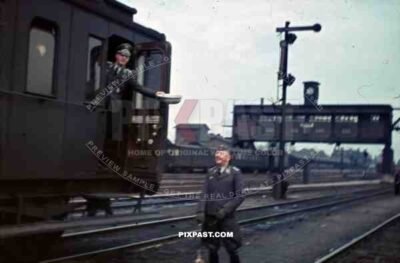
Luftwaffe Officers Cleaning Train Toilet at Stendal Railway Yard, Germany 1940
Add to cart -
Dzhumaya Mosque and Street Scene in Plovdiv, Bulgaria, 1942
Add to cart