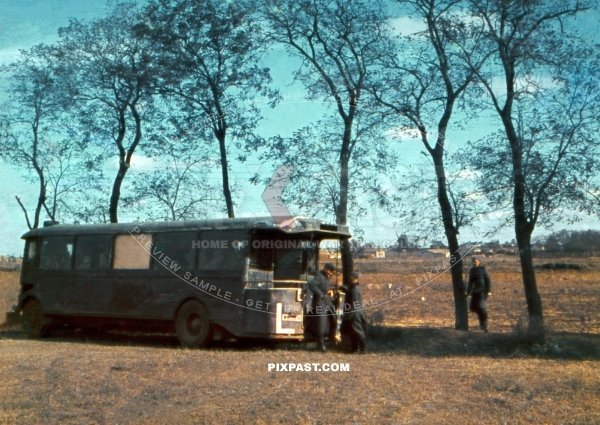
Captured French Renault TN Bus Used by German Wehrmacht Near Sevastopol, Crimea, 1942
Digital Download Only: Upon purchase and successful payment, you will receive the selected image as a high-resolution JPG digital download. No physical photographs or printed copies are included in this transaction.
File details: JPG • 5,000 × 3,541 pixels
Captured French Renault TN Bus Used by German Wehrmacht Near Sevastopol, Crimea, 1942
Description
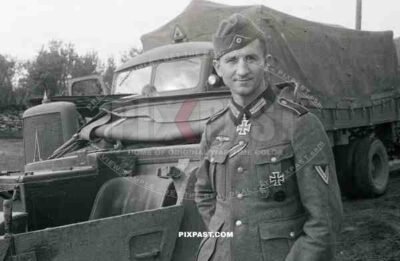
This historical color photograph shows a captured French Renault TN bus being used as a troop transport by the German Wehrmacht near Sevastopol in Crimea, Russia, in 1942. The bus, painted in a dark military livery, is parked on a barren field under sparse trees, with German soldiers nearby. The Renault TN series was widely used by the French army and later by German forces after its capture during World War II. The image captures a moment of wartime reuse of civilian and enemy vehicles by the German military on the Eastern Front. The bus features a long rectangular body with multiple windows and a rounded front, typical of 1930s French Renault commercial vehicles. The setting, with few structures visible in the distance, reflects the rural environment near Sevastopol during this period of the war.
Dieses historische Farbfoto zeigt einen erbeuteten französischen Renault TN-Bus, der 1942 von der deutschen Wehrmacht nahe Sewastopol auf der Krim, Russland, als Truppentransportfahrzeug genutzt wird. Der Bus, in einem dunklen Militäranstrich, steht auf einem kahlen Feld unter vereinzelten Bäumen, daneben sind deutsche Soldaten sichtbar. Die Renault-TN-Reihe wurde vom französischen Heer weit verbreitet eingesetzt und nach der Gefangennahme im Zweiten Weltkrieg von den deutschen Streitkräften übernommen. Das Bild zeigt einen Moment der Kriegszeit-Nutzung ziviler und gegnerischer Fahrzeuge durch das deutsche Militär an der Ostfront. Das Bus-Design mit langem rechteckigem Korpus und mehreren Fenstern sowie dem abgerundeten Frontbereich ist typisch für französische Renault-Nutzfahrzeuge der 1930er Jahre. Die ländliche Umgebung mit wenigen Gebäuden im Hintergrund entspricht der Region nahe Sewastopol zur Kriegszeit.