
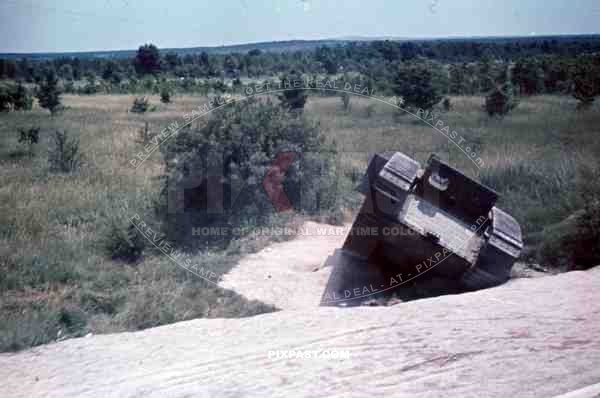
British Mark IV Tank in Russian Field, 1941
Digital Download Only: Upon purchase and successful payment, you will receive the selected image as a high-resolution JPG digital download. No physical photographs or printed copies are included in this transaction.
File details: JPG • 5,000 × 3,320 pixels
British Mark IV Tank in Russian Field, 1941
Description
This original color photograph shows a British Mark IV tank navigating rough terrain in a rural field. The vehicle and its crew are visible against a backdrop of sparse trees and grassland stretching to the horizon under a blue sky. According to the archive filename and notes, the image is linked to Russia in 1941 and associated with the 19th Panzer Division.
Although the filename references "first world war panzer russia 1942," the presence of a British World War I-era Mark IV tank—produced during World War I—fits the idea of captured or reused equipment during fighting on the Eastern Front in the Second World War. The archival context supports interpreting this as a captured British tank in Russian territory around 1941, not a German panzer tank. The terrain suggests a rural, relatively open field typical of the East European environment during the war.
Dieses Original-Farbfoto zeigt einen britischen Mark-IV-Panzer, der sich durch unwegsames Gelände in einem ländlichen Feld bewegt. Das Fahrzeug und die Besatzungsmitglieder sind vor einem Hintergrund aus vereinzelten Bäumen und Grasland sichtbar, das sich bis zum Horizont unter blauem Himmel erstreckt. Laut Archivdateiname und -hinweisen wird das Bild mit Russland im Jahr 1941 in Verbindung gebracht, verbunden mit der 19. Panzer-Division. Trotz der Erwähnung von „first world war panzer russia 1942“ im Dateinamen ist das britische Panzerfahrzeug aus dem Ersten Weltkrieg (der Mark IV wurde im Ersten Weltkrieg produziert) mit der Darstellung von erbeuteter oder wiederverwendeter Ausrüstung an der Ostfront im Zweiten Weltkrieg vereinbar. Der Archivkontext unterstützt die Interpretation als britischer erbeuteter Panzer auf russischem Gebiet um 1941 und nicht als Panzerfahrzeug der deutschen Wehrmacht. Das umliegende Terrain deutet auf ein ländliches, relativ offenes Feld hin, typisch für die osteuropäische Umgebung während des Krieges.
Related products
-
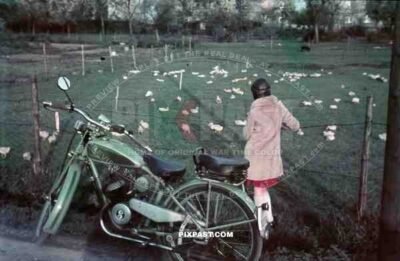
Woman in Red Skirt and Leather Helmet with Motorcycle Watching Ducks in Bremerhaven, Germany, 1939
Add to cart -
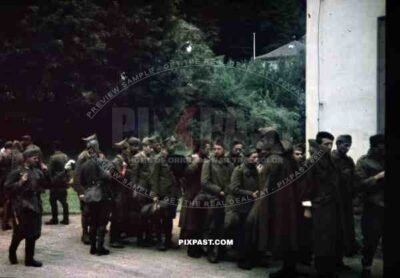
French Army POW Soldiers Near Verdun, France, 1940
Add to cart -
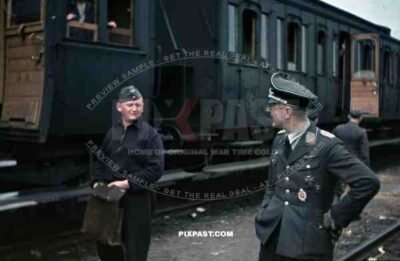
Luftwaffe Pilot with Awards at Railway Yard, Stendal, Germany, 1940
Add to cart -
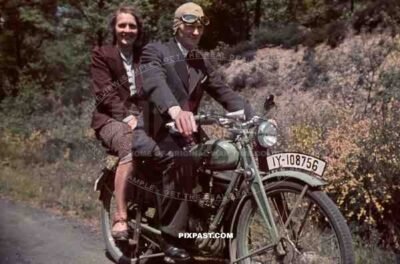
Bremerhaven 1939 NSU Motorcycle with Riding License IY-108756, Helmet and Goggles
Add to cart