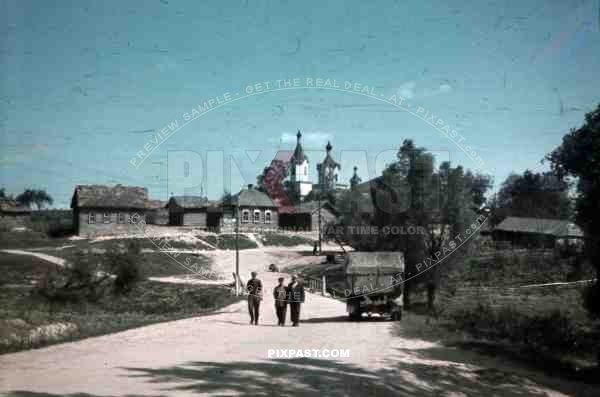
Bryansk 1941, Church and Town Scene with German Army Men and Supply Truck
Digital Download Only: Upon purchase and successful payment, you will receive the selected image as a high-resolution JPG digital download. No physical photographs or printed copies are included in this transaction.
File details: JPG • 5,000 × 3,308 pixels
Bryansk 1941, Church and Town Scene with German Army Men and Supply Truck
Description
This color photograph captures a rural town scene in Bryansk, Russia, in 1941 during the German military occupation of World War II. It shows two uniformed German soldiers walking along a road, accompanied by a supply truck. Traditional wooden houses and a church with onion domes appear in the background. The architecture reflects the Eastern European rural style common in the Bryansk region.
The filename and archive context link this scene to the 10th Motorised Infantry Division’s repair workshop (Werkstatt) activities in Bryansk. This image provides a valuable visual record of military presence and village life in occupied Soviet territory during the early 1940s. The truck and uniforms confirm German military affiliation, supporting the identification of the time and place. No specific vehicle model is clearly visible and is therefore not included.
Dieses Farbfoto zeigt eine ländliche Stadtszene in Brjansk, Russland, im Jahr 1941 während der deutschen Militärbesetzung im Zweiten Weltkrieg. Das Bild zeigt zwei uniformierte deutsche Soldaten, die eine Straße entlanggehen, begleitet von einem Versorgungslastwagen, im Hintergrund traditionelle Holzhäuser und eine Kirche mit Zwiebeltürmen. Die Szenerie entspricht der osteuropäischen ländlichen Architektur, die in der Region Brjansk üblich ist. Der Dateiname und der vorhandene Archivkontext deuten darauf hin, dass diese Szene mit den Reparaturwerkstätten (Werkstatt) der 10. motorisierten Infanteriedivision in Brjansk zusammenhängt. Das Foto ist ein wertvolles visuelles Dokument für die militärische Präsenz und das Dorfleben im besetzten sowjetischen Gebiet Anfang der 1940er Jahre. Der Lastwagen und die Uniformen bestätigen die Zugehörigkeit zur deutschen Wehrmacht und stützen die Identifikation von Zeit und Ort. Ein spezifisches Fahrzeugmodell ist aufgrund der sichtbaren Details nicht eindeutig identifizierbar und wurde daher nicht genannt.