
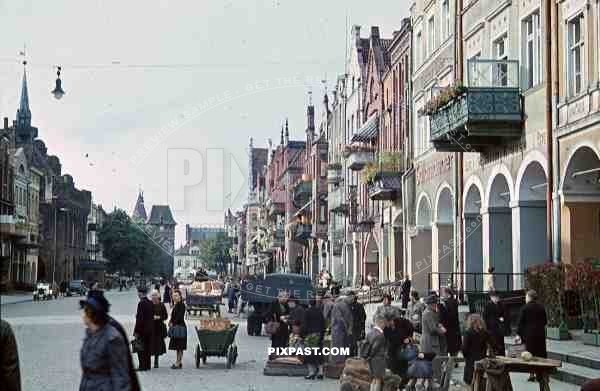
Street Scene in Marienburg (Malbork), Germany 1941 Featuring Period Vehicles and Town Architecture
Digital Download Only: Upon purchase and successful payment, you will receive the selected image as a high-resolution JPG digital download. No physical photographs or printed copies are included in this transaction.
File details: JPG • 5,000 × 3,262 pixels
Street Scene in Marienburg (Malbork), Germany 1941 Featuring Period Vehicles and Town Architecture
Description
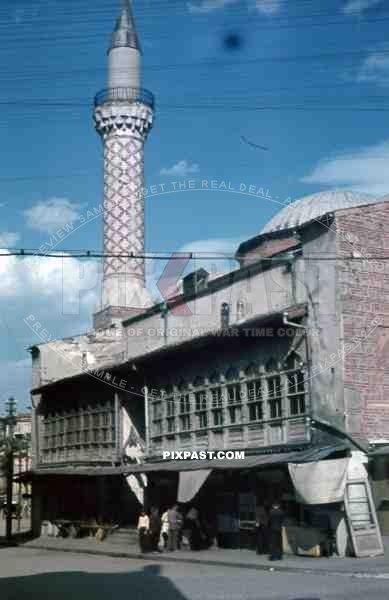
This original historical color photograph captures a busy street in Marienburg (now Malbork), Germany, in 1941. The scene shows a mix of pedestrians and market activity along a street lined with multi-story historic buildings featuring arcades. Street furniture and market stalls are visible, with people engaged in commercial and social interactions.
Architectural landmarks, such as the water tower and town hall, stand out in the distance, identifiable by their distinctive structures. Several motor vehicles and horse-drawn carts are parked or moving along the street, reflecting the early 1940s period. The vehicles appear to be German makes typical of that era, though no specific models can be confidently identified from the image.
The presence of civilians and lively street life offers a striking contrast to the wartime context of 1941 Germany. This photograph serves as a valuable historical record of urban civilian life during World War II.
Dieses originale historische Farbfoto zeigt eine belebte Straße in Marienburg (heute Malbork), Deutschland im Jahr 1941. Die Szene zeigt eine Mischung aus Fußgängern und Marktatmosphäre entlang einer Straße, die von mehrstöckigen historischen Gebäuden mit Arkaden gesäumt ist. Straßenmöbel und Marktstände sind sichtbar, Menschen interagieren in einem kommerziellen oder sozialen Umfeld. Architektonisch markante Merkmale sind der Wasserturm und das Rathaus in der Ferne, erkennbar an ihren charakteristischen Bauwerken. Mehrere Kraftfahrzeuge und Pferdefuhrwerke sind geparkt oder bewegen sich auf der Straße, was mit dem frühen 1940er-Jahre-Zeitraum übereinstimmt. Sichtbare Fahrzeugdetails deuten auf deutsche Marken der damaligen Zeit hin, jedoch können keine genauen Modelle sicher identifiziert werden. Die Anwesenheit von Zivilisten und lebhaftem Straßenleben steht im Kontrast zum Kriegskontext des Jahres 1941 in Deutschland, was das Foto zu einem wertvollen historischen Dokument des städtischen Zivillebens im Zweiten Weltkrieg macht.
Related products
-
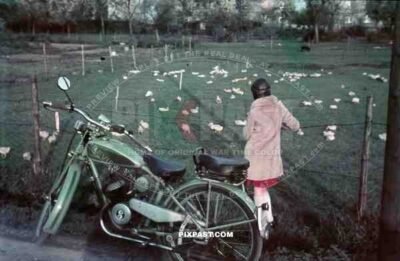
Woman in Red Skirt and Leather Helmet with Motorcycle Watching Ducks in Bremerhaven, Germany, 1939
Add to cart -
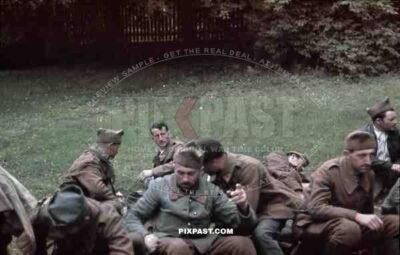
French Army POW Soldiers Near Verdun, France, 1940
Add to cart -
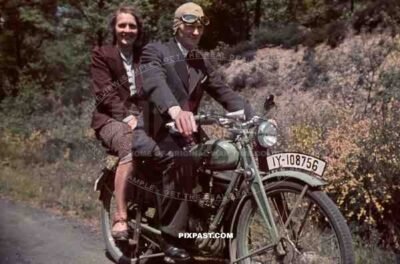
Bremerhaven 1939 NSU Motorcycle with Riding License IY-108756, Helmet and Goggles
Add to cart -
Dzhumaya Mosque and Market Buildings in Plovdiv, Bulgaria 1942
Add to cart