

British Steam Locomotive Pulling Cargo Train into London Station, 1944
Digital Download Only: Upon purchase and successful payment, you will receive the selected image as a high-resolution JPG digital download. No physical photographs or printed copies are included in this transaction.
File details: JPG • 5,000 × 3,491 pixels
British Steam Locomotive Pulling Cargo Train into London Station, 1944
Description
This original wartime color photograph shows a British steam locomotive hauling a cargo train into a railway station in London, England, dated 1944 according to archive records. The locomotive is seen from the front, emitting steam, with a long line of freight wagons behind it. The station platform on the right, the tracks, and surrounding infrastructure display typical mid-20th century British railway architecture.
The photograph captures a moment of domestic logistical operation during wartime. The filename "IMG526_cleaned" provides no additional location or date information beyond the archival context. The archive notes indicate the photo was shot with Agfacolor, highlighting its historical documentary value. Although the owner’s note mentions Germany in 1940, the architectural features and locomotive strongly support a British origin around 1944. Due to limited visible detail, no specific locomotive manufacturer or class can be confidently identified.
Dieses original farbige Kriegsfoto zeigt eine britische Dampflokomotive, die 1944 laut Archivangaben einen Güterzug in einen Bahnhof in London, England, einfährt. Die Lokomotive ist frontseitig mit Dampfausstoß sichtbar, hinter ihr ist eine lange Güterzugwagenfolge zu erkennen. Der Bahnsteig rechts, die Gleise und die umliegende Infrastruktur zeigen typische britische Eisenbahnarchitektur der Mitte des 20. Jahrhunderts. Das Foto hält eine Inlandstransportoperation in Kriegszeiten fest. Der Dateiname „IMG526_cleaned“ bietet keine zusätzlichen Angaben. Das Archiv gibt 1944 und London als sicher an, trotz des Hinweises auf Deutschland 1940. Sichtbare Merkmale unterstützen stark den britischen Ursprung. Eine genaue Lokomotividentifikation ist aufgrund fehlender Details nicht möglich.
Related products
-

Luftwaffe Soldiers by Train Wagon at Stendal Railway Yard, Germany 1940
Add to cart -
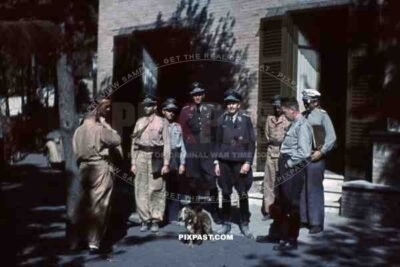
German Luftwaffe Officers Meeting for Strategy in Sicily, 1943
Add to cart -
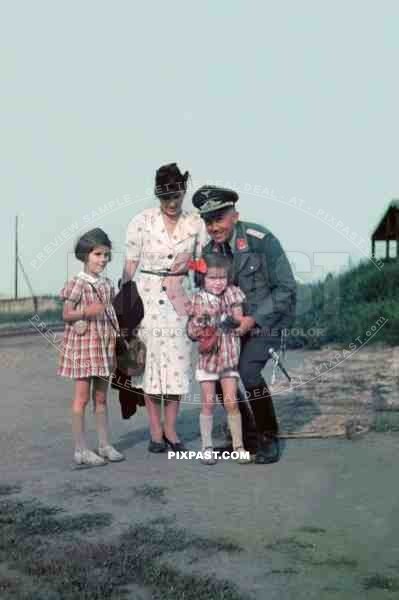
Germany Thuringen 1940 German Luftwaffe FLAK Officer in Uniform with Family
Add to cart -
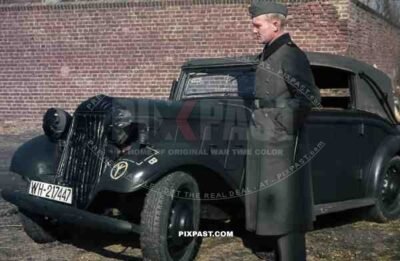
Wehrmacht Soldier Standing Beside 1938 Adler 2 Liter Cabriolet in Niederaußem, Germany 1940
Add to cart