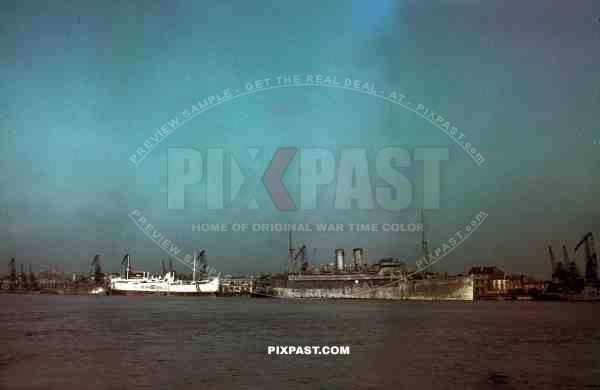
Captured Passenger Ship Empress of Australia or De Grasse in Bordeaux Harbour, France 1940
Digital Download Only: Upon purchase and successful payment, you will receive the selected image as a high-resolution JPG digital download. No physical photographs or printed copies are included in this transaction.
File details: JPG • 5,000 × 3,258 pixels
Captured Passenger Ship Empress of Australia or De Grasse in Bordeaux Harbour, France 1940
Description
This original color photograph shows Bordeaux Harbour, France, in 1940 during World War II. Two large passenger or cargo ships are docked alongside each other—one white and the other darker. Both appear to be captured or interned vessels. The cream-colored ship on the right may be the Empress of Australia or the French liner De Grasse, as suggested by archive context. A smaller white ship with a red funnel is alongside it, possibly the Swedish cargo ship Sverige noted in archive research.
The scene is set in a busy industrial port area, with cranes and dockside buildings visible in the background. The photo was likely taken during the German occupation, as indicated by the 9th Infantry Division reference and the 1940 date. It was captured on Agfacolor film, typical of mid-20th century German wartime photography. No clearly identifiable vehicles appear in the shot beyond the ships.
Cette photographie couleur originale montre le port de Bordeaux, France, en 1940 pendant la Seconde Guerre mondiale. Deux grands navires de passagers ou cargos sont visibles amarrés côte à côte, l’un blanc et l’autre plus foncé, semblant être des navires capturés ou internés. Le navire de couleur crème à droite pourrait être l’Empress of Australia ou le paquebot français De Grasse, comme le suggère le contexte d’archive. Un navire blanc plus petit avec une cheminée rouge est visible à côté, probablement le cargo suédois Sverige mentionné dans les recherches d’archives. Situé dans une zone portuaire industrielle animée, des grues et des bâtiments du quai sont visibles en arrière-plan. La photo a probablement été prise pendant l’occupation allemande, comme l’indique la référence à la 9e division d’infanterie et la date de 1940. L’image a été capturée sur film Agfacolor, typique de la photographie allemande de guerre du milieu du 20e siècle. Aucun véhicule identifiable n’est visible autre que les navires.