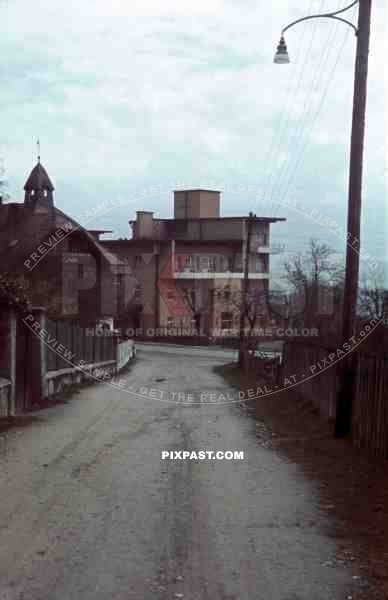
Street View Below the Hungerburgbahn in Innsbruck, Austria, 1940
Digital Download Only: Upon purchase and successful payment, you will receive the selected image as a high-resolution JPG digital download. No physical photographs or printed copies are included in this transaction.
File details: JPG • 3,241 × 5,000 pixels
Street View Below the Hungerburgbahn in Innsbruck, Austria, 1940
Description
This original historical color photograph, dated 1940, shows a quiet street scene below the Hungerburgbahn funicular railway in Innsbruck, Austria. It captures a modest residential area with a dirt road lined by wooden fences and a lamppost with overhead wiring. In the midground, a distinctive building with a steep roof and a flat-roofed structure stand against a cloudy sky.
The photograph is an Agfacolor slide from the World War II period, focusing on everyday life in the city rather than military or industrial activity. No clearly identifiable vehicle or specific event appears in the image. The filename and archive metadata strongly support the location as Innsbruck and the date as 1940. The architecture and environment fit well with a mid-20th-century Alpine town. This image captures a moment of local civilian life during a historically significant era in Austria.
Dieses originale Farbfoto zeigt eine ruhige Straßenszene unterhalb der Hungerburgbahn in Innsbruck, Österreich, datiert auf 1940. Das Bild zeigt ein bescheidenes Wohngebiet mit einer unbefestigten Straße, die von Holzzäunen und einer Straßenlaterne mit Oberleitungen gesäumt ist. Ein markantes Gebäude mit steilem Dach und ein weiteres mit Flachdach sind im Hintergrund zu sehen, vor einem bewölkten Himmel. Die Aufnahme ist ein Agfacolor-Dias aus der Zeit des Zweiten Weltkriegs und zeigt eher den Alltagsleben in der Stadt als militärische oder industrielle Aktivitäten.
Es sind keine klar identifizierbaren Fahrzeuge oder spezifischen Ereignisse im Bild sichtbar. Die Dateinamen- und Archivmetadaten bestätigen den Standort Innsbruck, Österreich, und das Jahr 1940. Die sichtbare Architektur und Umgebung entsprechen gut dem Erscheinungsbild einer Alpenstadt in der Mitte des 20. Jahrhunderts. Das Foto hält einen Moment des lokalen Zivillebens während einer historisch bedeutenden Epoche in Österreich fest.