
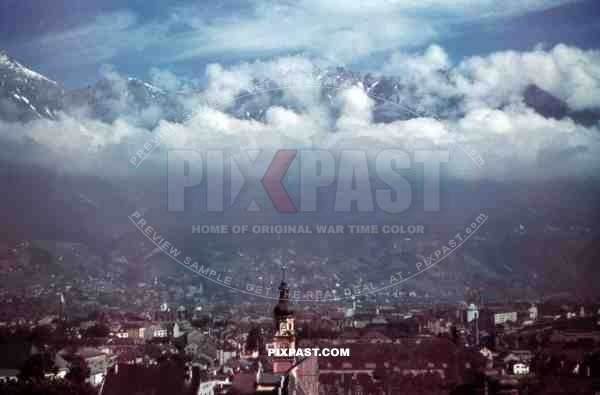
Abbey Church Wilten and Innsbruck Skyline with Alps, Austria, circa 1940
Digital Download Only: Upon purchase and successful payment, you will receive the selected image as a high-resolution JPG digital download. No physical photographs or printed copies are included in this transaction.
File details: JPG • 5,000 × 3,294 pixels
Abbey Church Wilten and Innsbruck Skyline with Alps, Austria, circa 1940
Description
This original color photograph shows a panoramic view of Innsbruck, Austria, around 1940. It prominently features the Abbey Church Wilten in the foreground. The image captures a wide urban skyline nestled among the Alps, with distinctive mountain peaks partly obscured by clouds in the background.
The abbey church’s twin towers, topped with onion domes, stand out clearly in the cityscape, matching the historic Wilten Abbey church. The photograph’s color tonality and detail suggest it is an authentic early color image, likely an Agfacolor slide from the wartime period. No vehicles or military hardware are visible in the cityscape.
This scene provides valuable documentation of Innsbruck’s urban and religious landmarks in early 20th-century Austria. Though the filename offers limited clues, the archival context confirming the location and approximate date aligns with the visible evidence.
Dieses Originalfarbfoto zeigt eine Panoramaaufnahme von Innsbruck, Österreich, um 1940, mit Fokus auf die Stiftskirche Wilten, die prominent im Vordergrund zu sehen ist. Das Bild zeigt die breite Stadtsilhouette, eingebettet in die Alpen, wobei markante Berggipfel teilweise von Wolken verdeckt sind. Die Zwillingstürme der Abteikirche mit Zwiebeldächern heben sich deutlich in der Stadtsilhouette ab, was mit der historischen Stiftskirche Wilten übereinstimmt. Die Farbgebung und Details des Fotos deuten auf ein authentisches frühes Farbbild hin, wahrscheinlich eine Agfacolor-Dias aus der Kriegszeit. Im Stadtbild sind keine Fahrzeuge oder militärische Ausrüstung erkennbar. Diese Aufnahme liefert wertvolle visuelle Dokumentation der städtischen und religiösen Wahrzeichen Innsbrucks Anfang des 20. Jahrhunderts in Österreich. Die Dateinamenhinweise sind begrenzt, doch der Archivkontext bestätigt Standort und ungefähres Datum, was mit den sichtbaren Beweisen übereinstimmt.
Related products
-
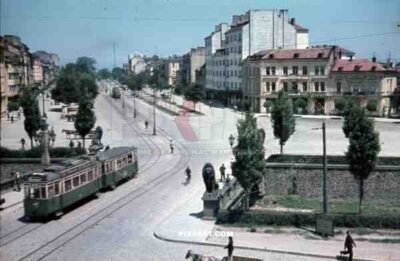
Lions Bridge with Tram in Sofia, Bulgaria, 1942
Add to cart -
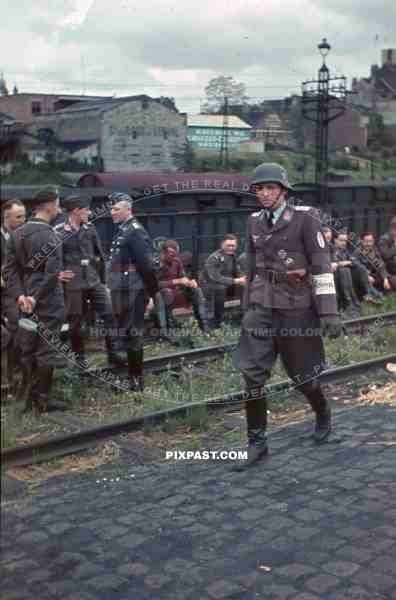
Luftwaffe Field Division Soldiers at Train Station, Etterbeek, Brussels, Belgium, 1941
Add to cart -
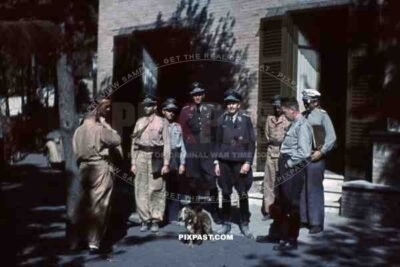
German Luftwaffe Officers Meeting for Strategy in Sicily, 1943
Add to cart -
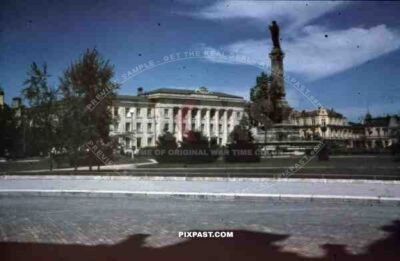
Liberty Monument and Courthouse in Ruse, Bulgaria, 1943
Add to cart