

Interior Dome View of the Volkerschlachtdenkmal Monument, Leipzig, June 1945
Digital Download Only: Upon purchase and successful payment, you will receive the selected image as a high-resolution JPG digital download. No physical photographs or printed copies are included in this transaction.
File details: JPG • 3,423 × 5,000 pixels
Interior Dome View of the Volkerschlachtdenkmal Monument, Leipzig, June 1945
Description
This photograph shows the interior of the dome of the Volkerschlachtdenkmal (Monument to the Battle of the Nations) in Leipzig, Germany, taken in June 1945. The circular dome features a series of rectangular windows arranged symmetrically, allowing natural light to enter the otherwise dim space. The black-and-white photo appears to have been taken from the center, looking directly upward at the dome ceiling.
The Volkerschlachtdenkmal commemorates the Battle of Leipzig (1813), a major conflict during the Napoleonic Wars. The filename and archive context confirm the location as Leipzig and the date as June 1945, shortly after the end of World War II. This timing adds historical significance as a post-war record of the monument. No vehicles or military units are visible inside the dome. The photo is valuable for architectural and historical study of this landmark in mid-20th-century Germany.
Dieses Foto zeigt den Innenraum der Kuppel des Volkerschlachtdenkmals in Leipzig, Deutschland, aufgenommen im Juni 1945. Das Bild zeigt die zylindrische Innenkuppel mit einer Reihe rechteckiger Fenster, die symmetrisch um die Kuppel angeordnet sind und natürliches Licht in den ansonsten dunklen Raum lassen. Das Foto ist schwarz-weiß und wurde offenbar aus der Mitte aufgenommen, mit Blick direkt nach oben zur Kuppeldecke. Das Volkerschlachtdenkmal erinnert an die Völkerschlacht bei Leipzig (1813), einen bedeutenden Konflikt während der Napoleonischen Kriege. Der Dateiname und die Archivinformationen bestätigen den Standort Leipzig, Deutschland, sowie das Datum Juni 1945, kurz nach Ende des Zweiten Weltkriegs, was eine historische Bedeutung als Nachkriegsdokumentation dieses monumentalen Bauwerks bietet. Im Bild sind keine Fahrzeuge oder militärischen Einheiten in der Kuppel sichtbar. Das Foto ist somit wertvoll für das architektonische und historische Studium des Denkmals im Deutschland der Mitte des 20. Jahrhunderts.
Related products
-
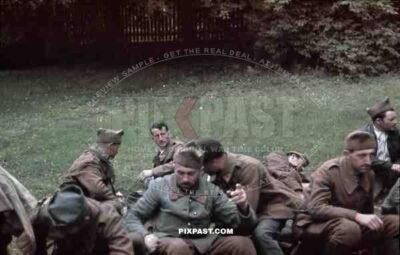
French Army POW Soldiers Near Verdun, France, 1940
Add to cart -

Bremerhaven 1939 NSU Motorcycle with Riding License IY-108756, Helmet and Goggles
Add to cart -
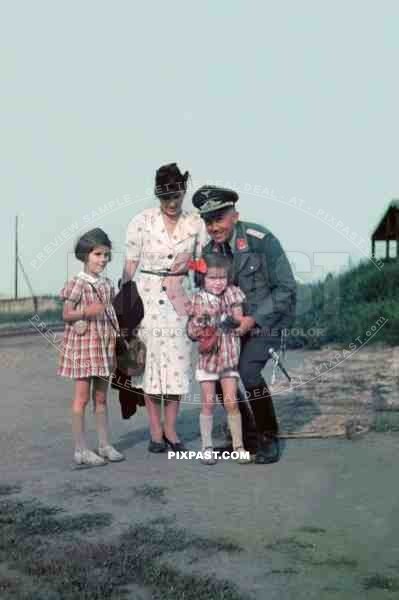
Germany Thuringen 1940 German Luftwaffe FLAK Officer in Uniform with Family
Add to cart -
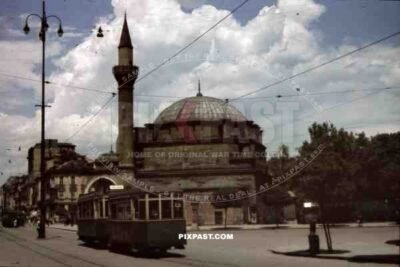
Banja-Baschi Mosque and Sofia Tram, Bulgaria 1942
Add to cart