
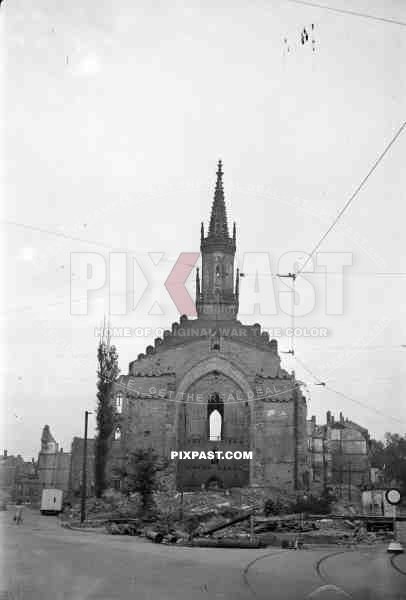
Remains of Johanniskirche Chapel near Leipzig University, June 1945
Digital Download Only: Upon purchase and successful payment, you will receive the selected image as a high-resolution JPG digital download. No physical photographs or printed copies are included in this transaction.
File details: JPG • 3,391 × 5,000 pixels
Remains of Johanniskirche Chapel near Leipzig University, June 1945
Description
This black-and-white photograph shows the ruins of the Johanniskirche chapel near Leipzig University in Germany, taken in June 1945. The chapel, heavily damaged during World War II, stands mostly roofless. Its prominent Gothic spire remains intact but bears visible scars. Nearby buildings also display war damage, with rubble and debris scattered around the site. Overhead tram or electric lines are visible, highlighting the chapel’s urban location near the university.
This image documents the destruction suffered by cultural and religious buildings in Leipzig during the war’s final months. The filename states June 1945, which aligns with the post-war condition shown by the extensive ruins and the lack of active military presence. No vehicles are clearly visible. The architectural features confirm the building’s Gothic style, consistent with the Johanniskirche chapel.
Dieses Schwarz-Weiß-Foto zeigt die Ruinen der Johanniskirche, nahe der Universität Leipzig in Deutschland, fotografiert im Juni 1945. Die Kapelle, die im Zweiten Weltkrieg stark beschädigt wurde, steht größtenteils ohne Dach, wobei ihr markanter gotischer Turm intakt, aber sichtbar beschädigt ist. Die umliegenden Gebäude zeigen ebenfalls Kriegsschäden, mit Trümmern und Schutt um das Gelände herum. Über der Straße sind Straßenbahn- oder Elektroleitungen zu sehen, was auf die städtische Lage nahe der Universität Leipzig hinweist. Dieses Bild dokumentiert die Zerstörung kultureller und religiöser Gebäude in Leipzig gegen Kriegsende. Die Angaben im Dateinamen zu Juni 1945 passen zur Nachkriegszeit, erkennbar an den umfangreichen Ruinen und dem Fehlen einer aktiven Militärpräsenz. Fahrzeuge sind im Bild nicht klar erkennbar. Die architektonischen Merkmale bestätigen den gotischen Stil, der mit der identifizierten Johanniskirche übereinstimmt.
Related products
-
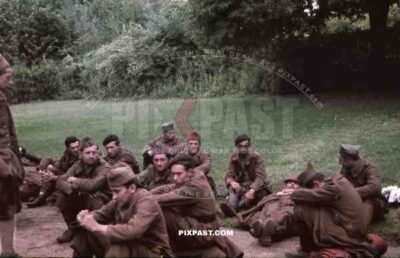
French Army POW Soldiers Near Verdun, France, 1940
Add to cart -
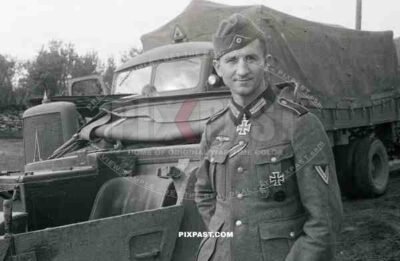
Obergefreiter Richard Gambietz with German Military Truck, Russia 1942
Add to cart -
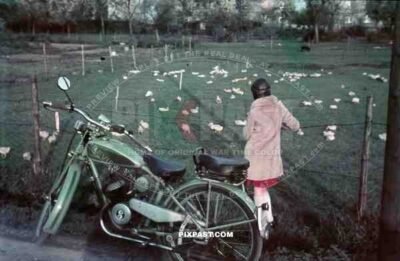
Woman in Red Skirt and Leather Helmet with Motorcycle Watching Ducks in Bremerhaven, Germany, 1939
Add to cart -
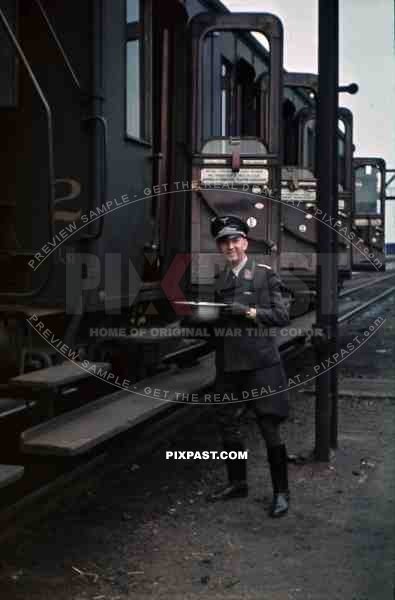
Luftwaffe Officer at Railway Carriage in Stendal, Germany, 1940
Add to cart